


Today’s fractious politics increasingly frame society as a zero-sum competition in which one group’s flourishing must come at another’s expense, a mindset now evident across both progressive and ethnonationalist movements. Drawing on the biblical vision of divine abundance, Jide Ehizele calls Christians to resist these mutually hostile rivalries and recover confidence in the Christian moral imagination.
The idea that life is a competition is not a new phenomenon. Human beings have always been familiar with the language of loss and gain. In many areas of life this is perfectly natural. It is most clearly expressed in arenas deliberately designed to produce winners and losers, sports and elections being the most obvious examples.
Yet in these cases there is an implicit understanding that the competition exists within the boundaries of the game. Rivalry is the mechanism through which the objective is pursued. Frustration and elation may follow depending on which side one finds oneself on, but the contest remains governed by shared rules. Once the game ends, the rivalry does not define the whole of social life.
Increasingly, however, this competitive logic is spilling beyond those bounded arenas into areas such as politics, race, and sex. Public life is now frequently narrated as if one group’s gain must necessarily come at another’s expense. What once belonged to the playing field is becoming a framework for interpreting society itself.
The danger is that, unlike sport, where loss and victory are part of the design, here we are speaking about social relationships. The past decade has seen progressive movements often described as “woke” adopt this framework. Yet a reactionary right across the West is increasingly mirroring the same logic in its rhetoric around immigration and race.
In doing so, we have quietly allowed zero-sum thinking to shape our moral imagination. But this is not merely a political mistake. It is, more profoundly, a theological one. Christians must resist it rather than be swept along by its tide.
A zero-sum moral imagination is one in which flourishing is imagined as scarce, finite, and rivalrous. One group’s gain must necessarily come at another’s expense. When this assumption becomes a first principle, it reshapes moral perception. Those outside one’s tribe are easily interpreted as threats rather than neighbours.
We can see this logic at work in very different ideological traditions. In some progressive frameworks influenced by critical race theory, society is understood primarily through the distribution of privilege attached to racial categories, with equity conceived largely as the redistribution of social advantage. Yet the same underlying assumption also appears in ethnonationalist thinking, where demographic change is interpreted as a form of dispossession.
It is important to distinguish this from something more ordinary and legitimate: ethnic consciousness. A people may be aware of their heritage, their shared story, and their moral inheritance. Scripture itself reflects this reality in the life of Israel. But this differs fundamentally from policing belonging according to ethnic composition or treating identity as a resource that must be guarded against others.
The difficulty is that zero-sum thinking can quietly seep into Christian instincts as well. Many of us in the West now inhabit societies that are culturally post-Christian. Our imaginations are therefore shaped by ideas that do not arise from the gospel. Anxiety begins to replace trust. Identity is framed defensively. Faith becomes less a participation in the life of Christ and more a form of cultural alignment.
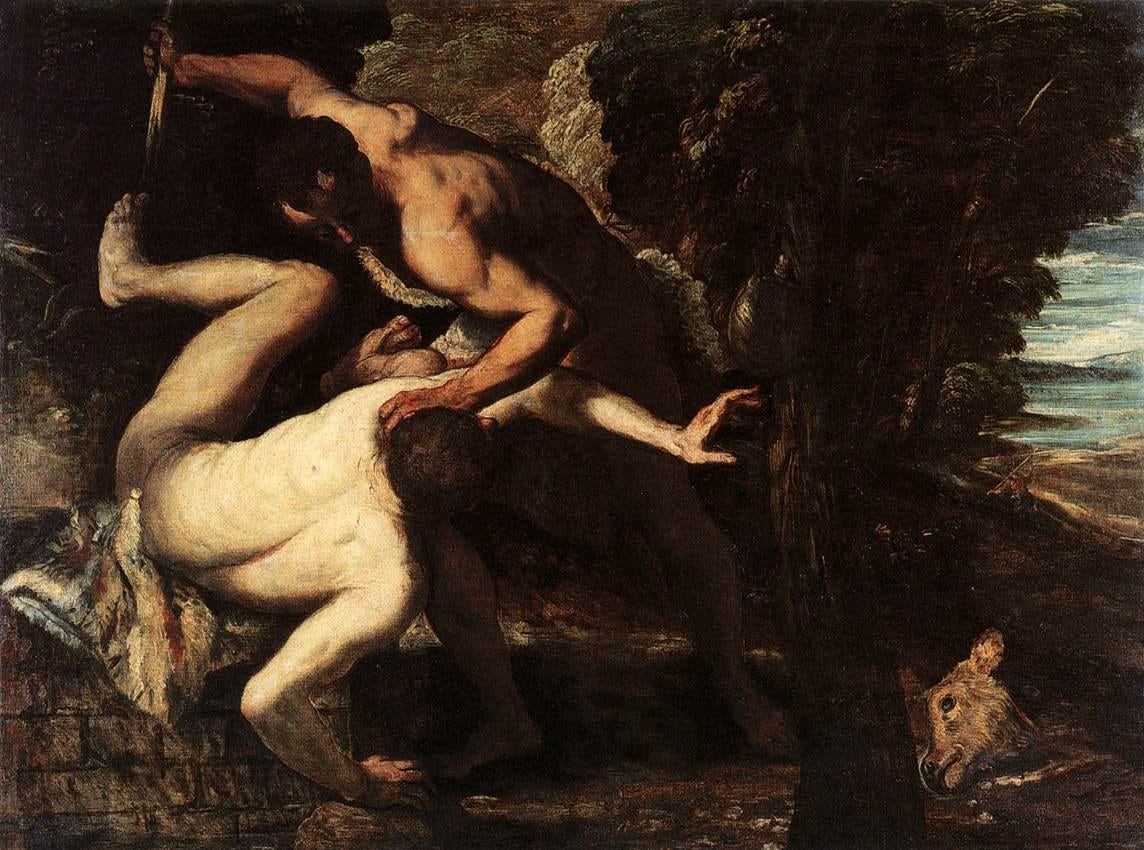
The Bible recognises this temptation early in the human story. In Genesis 4, Cain interprets God’s favour toward Abel as evidence of his own rejection. Yet nothing had been taken from him. The crisis lay not in Cain’s circumstance but in his imagination.
God’s warning to Cain reveals that rivalry is a temptation, not a necessity. Sin, God says, is “crouching at the door,” waiting to master him. When Cain chooses to believe that blessing is scarce, resentment hardens into violence and he murders his brother.
The pattern is tragically familiar. Again and again in human history, people interpret another’s presence as their own erasure. What begins as comparison becomes rivalry, and rivalry easily becomes hostility.
Scripture consistently bears witness to divine abundance as the true character of God’s kingdom. Abraham is blessed so that all nations might share in that blessing. Israel is chosen not for exclusion but for mediation. Jesus feeds the multitudes. Provision multiplies and even leftovers remain. At Pentecost, difference is not erased but gathered into unity.
The wider biblical narrative resists the assumption that identity and belonging must be secured through competition. God’s economy is not zero-sum but superabundant.
Yet we must acknowledge that these are anxious times. Globalisation and rapid technological change have forced many societies to reconsider what it means to be human in a world that now offers competing narratives about identity, belonging, and purpose.
In such an atmosphere, Christians may be tempted to treat faith as a tool of preservation. The gospel risks becoming a badge of cultural belonging rather than a participation in divine life. But historically Christianity did not spread by defending territory. It spread through communities marked by radical charity, holiness, and confidence in God’s providence.
The gospel is not merely an ethical system but a divine truth that incarnates itself within every age. If we believe Jesus when he says that his words will never pass away (Luke 21:33), then the question facing believers is not ultimately how Christianity can be defended, but how it can be faithfully lived in our present moment.
When the Church allows fear to become its animating mood, it ceases to be salt and light.
The New Testament itself addresses this temptation. Writing to Christians living in a plural and shifting world, Paul does not call the Church to secure its position within society but to grow into maturity in Christ (Ephesians 4). Spiritual infancy, he writes, is marked by being “tossed to and fro by the waves and carried about by every wind of doctrine.” It is a state easily unsettled by every cultural current, including waves of panic.
Christian maturity, by contrast, is a stability grounded in the fullness of Christ rather than in demographic or political reassurance.
This maturity presents itself as confidence without hostility, a pride in identity without exclusion, and a presence without panic. It does not mean avoiding the real and often contentious questions surrounding immigration, social cohesion, and morality. Rather, it means confronting such matters with humility and grace while holding fast to the conviction that the dignity of every person is preserved by the gospel.
In this way the Church becomes a community where life is received as gift rather than secured through comparison. Here Christians model a different way of inhabiting change.
The crisis facing the West is not only political or demographic, but moral and spiritual. Christians must refuse the ancient lie that there is not enough goodness, belonging, or future to share. The answer to fear is neither withdrawal nor domination, but growth into the inexhaustible life of Christ.
This means living out agape within our local communities and trusting in the economy of God rather than that of the world. In doing so, the Church offers not merely a defence of civilisation, but the possibility of its renewal. The Church does not renew civilisation by winning the rivalries of the age, but by living so fully in the life of Christ that rivalry itself loses its hold on the human imagination.
Jide Ehizele is a Christian thinker from South East London. Lewisham born and bred, he explores identity, faith, and cultural renewal through a Christian moral lens. You can find him at his Substack here.
Jide appears on the Leaving Egypt podcast in Episode 49: Local, Sacramental, Relational and Episode 57: African Christian Experience and a Changing West
Header image: The Murder of Abel, Jacopo Tintoretto (c. 1551–1552)
 | A guest post by
|
Christianity is mostly stolen from Roman Stoicism, but they added something that the Stoics would have found morally repugnant: vicarious redemption. That someone else - even a god - can take the blame for your crimes is not acceptable. Christianity is founded on sand.