



In this lecture, John Clifton challenges the prevailing culture of professionalised Christian charity. He asks searching questions of class, recognition, and moral location, exploring what the gospel offers those who have been marginalised by mainstream societies. Clifton argues that poor communities do not need a merely competent Christian social action; but an approach capable of truthful, holy, and proximate witness. Clifton, who is Divisional Commander of the Salvation Army’s North East Division in the UK, is addressing his European colleagues at a conference in Rome, challenging them to consider whether their public witness is disclosing Christ or merely protecting respectability. The Salvation Army is one of the most visible and active Christian organisations globally, it operates as both church and major social service provider in 35 European countries.
“Whose Side Are You On?”
A few years ago, in a previous Salvation Army appointment in East London, I was involved in a remarkable project.
Our Corps was building accommodation for people experiencing homelessness. In the UK, this would be a new way for The Salvation Army to do homelessness work. The corps itself was going to be responsible for the project, building upon the experience, credibility and relationships we had built up over nine years of running winter night shelters.
It was designed for people who had no recourse to public funds — people who, because of their immigration status, could not access the welfare systems available to others. As a result, many of them were dying on our streets, including ten in short succession.
To be honest, I was deeply proud of the project.
And I was proud not only of the project itself but also of the story we had built around it.
We had thought very carefully about the narrative.
At the centre of it was a young boy called Malachi, who had given us five pounds, money that he had received from the tooth fairy, and wrote a letter asking us to build homes for people who were homeless. He gave us that money because he trusted us and because he believed we would do something with it.
That five pounds eventually became a five-million-pound project – Project Malachi – which eventually turned into Malachi Place.
And the story carried extraordinary power.
For Salvationists, it became a story about rediscovering the original spirit of Salvationism — reconnecting social mission with congregational life, rather than outsourcing it elsewhere.
The building itself was going to stand on the site where the Salvation Army had first begun work in that town. So physically, symbolically, and spiritually, it felt like a return to our origins.
Before that, the site had been a funeral director’s.
So there was even a language of resurrection attached to it — turning a place associated with death into a place of life.
It was an innovative approach to building – using a redundant piece of land and modular construction methods to make the most of something that was not being used.
And around the project gathered an unusually broad coalition of people:
Muslims, Sikhs, Christians from different traditions, political leaders from different parties, community activists, and local residents.
People rallied around it.
The Salvation Army became a catalyst for collective action and civic imagination.
And the story travelled.
There was local, regional, and national media coverage.
We celebrated it.
And rightly so.
But at the same time, I remember standing in the upstairs hall of our Salvation Army building, where we ran the night shelter.
And I remember speaking to a man who had been coming to us for many months.
He had once been a taxi driver.
But after a relationship breakdown and a complicated set of circumstances, he had found himself homeless, isolated, and unable to access the systems that might have helped him rebuild his life, despite having paid into them for years through tax.
But because of his particular status, he would not qualify for the accommodation we were building.
I remember him looking at me and saying:
“This isn’t going to help me, is it.
What about me?”
It is the sort of question that should stop you in your tracks.
But at the time, it did not stop me enough.
The project had momentum.
There was an energy in the team.
There was institutional affirmation.
Funding had been secured.
The story was working.
And yet here was a man standing directly in front of me, asking:
“What about me?”
I have thought about that moment often, but especially in recent days as my country, the United Kingdom, has become more and more polarised, a polarisation we are seeing across Europe and what the Edelman Trust Barometer has described as society sliding from polarisation to grievance to insularity.
More and more people are asking ‘what about me?’
Because I realise now that, in a profound sense, I was not on his side.
And I should have been.
But I saw him as someone who had everything he needed.
And he was difficult to get along with.
At times he expressed his anger in racism, misogyny, and general disruptiveness verging on violence. But poverty and disenfranchisement aren’t romantic or sanctifying. But what should I have expected?
While absolute power corrupts absolutely, so too does absolute powerlessness.
And at that time, he was indeed powerless.
Eventually his behaviour reached a point where we had to ask him to leave the night shelter, and we lost touch with him.
Meanwhile, Malachi Place opened.
We accommodated hundreds of people.
But, to borrow the language of scripture, one sheep was lost.
He was that lost sheep.
Some months later, during lockdowns in COVID-19, I saw him again walking through the streets in a different part of London.
He looked utterly different.
His hair was matted; his beard, overgrown.
He looked exhausted, isolated, and dislocated.
I recognised him only because I recognised his eyes.
Maybe I should have approached him.
I didn’t.
I was afraid.
And I realised, with some shame, that I no longer knew what I had to offer him.
The abundant love and compassion poured out on others was not there for him in the same way, and I felt I had nothing to offer him anymore.
And I remember thinking:
The project succeeded.
The funding succeeded.
The publicity succeeded.
We replicated it in a couple of other places.
We helped so many people.
But for one man standing in front of me, none of it meant salvation.
I do not share that story as an exercise in self-condemnation.
I share it because I think institutional narratives can unintentionally produce blindness.
It is possible to do good things – to build coherent, compelling, publicly celebrated stories – and still fail to hear and respond in solidarity with the people who remain outside them.
And over time, I have increasingly come to believe that one of the most frightening passages in Scripture for Christian institutions is Matthew 25:31-46.
This will be a crucial lens for us as we consider The Salvation Army’s witness in Europe, which I argue is primarily about morally located Christian presence: where we stand, with whom we stand, and whether our public witness reveals, points to, and encounters Christ present among the fractures of European life.
Let’s read the passage in full:
“When the Son of Man comes in his glory and all the angels with him, then he will sit on the throne of his glory. 32 All the nations will be gathered before him, and he will separate people one from another as a shepherd separates the sheep from the goats, 33 and he will put the sheep at his right hand and the goats at the left. 34 Then the king will say to those at his right hand, ‘Come, you who are blessed by my Father, inherit the kingdom prepared for you from the foundation of the world, 35 for I was hungry and you gave me food, I was thirsty and you gave me something to drink, I was a stranger and you welcomed me, 36 I was naked and you gave me clothing, I was sick and you took care of me, I was in prison and you visited me.’ 37 Then the righteous will answer him, ‘Lord, when was it that we saw you hungry and gave you food or thirsty and gave you something to drink? 38 And when was it that we saw you a stranger and welcomed you or naked and gave you clothing? 39 And when was it that we saw you sick or in prison and visited you?’ 40 And the king will answer them, ‘Truly I tell you, just as you did it to one of the least of these brothers and sisters of mine, you did it to me.’ 41 Then he will say to those at his left hand, ‘You who are accursed, depart from me into the eternal fire prepared for the devil and his angels, 42 for I was hungry and you gave me no food, I was thirsty and you gave me nothing to drink, 43 I was a stranger and you did not welcome me, naked and you did not give me clothing, sick and in prison and you did not visit me.’ 44 Then they also will answer, ‘Lord, when was it that we saw you hungry or thirsty or a stranger or naked or sick or in prison and did not take care of you?’ 45 Then he will answer them, ‘Truly I tell you, just as you did not do it to one of the least of these, you did not do it to me.’ 46 And these will go away into eternal punishment but the righteous into eternal life.”
Was the homeless man I described any less hungry, any less thirsty, any less estranged, lonely or sick than the other ones we accommodated?
Was Christ any less present amongst that one lost sheep of a man, than the 99 who we were able to help?
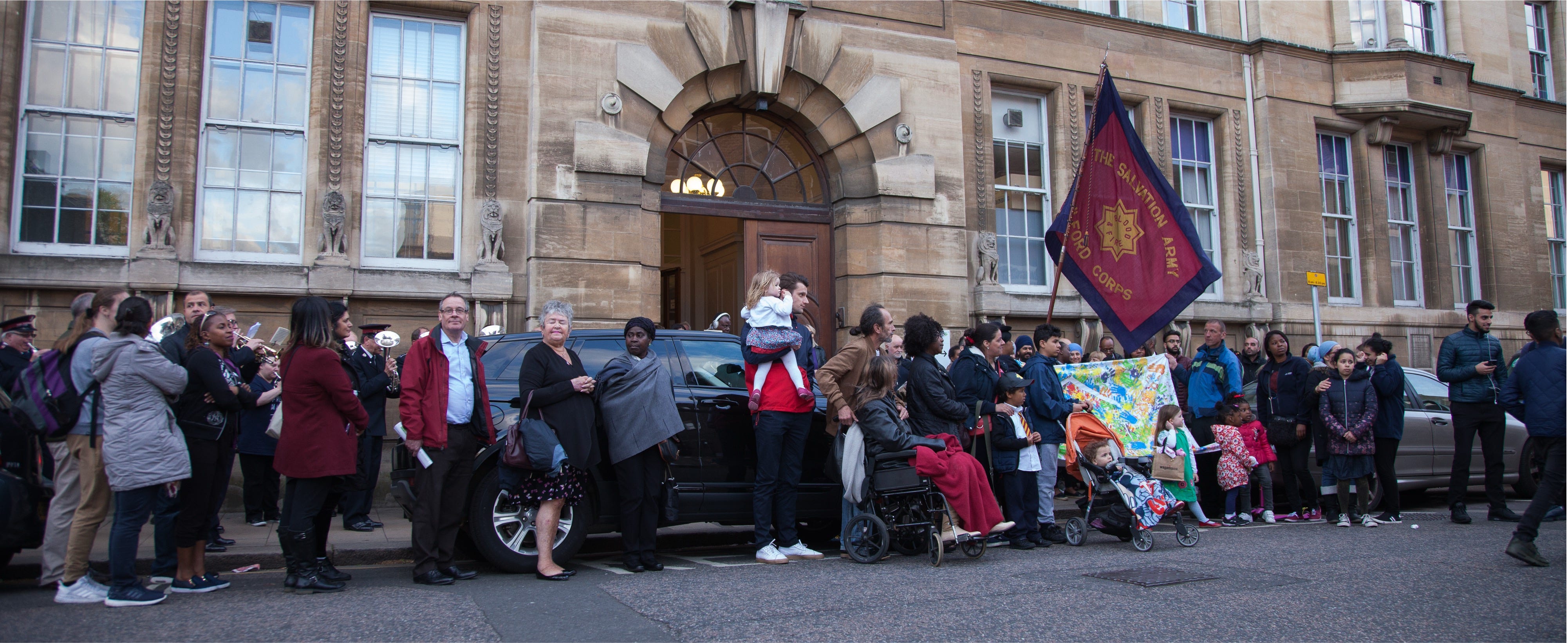
Over recent years, as I have spent more time outside London — especially in post-industrial communities carrying the wounds of economic decline, institutional retreat, us today is one of the defining questions facing institutions across Europe.
Who is seen?
Who is heard?
Who belongs?
Who remains outside our story?
And ultimately:
Whose side are we, The Salvation Army, on?
It is a dangerous question.
Because it can easily be misheard.
Or misrepresented.
Or perhaps most dangerously of all, reduced.
It can sound as though I am asking which political party we support, which ideological camp we belong to, which public argument we want to win, or which side of a cultural conflict we intend to occupy.
But those are not the questions I want to ask.
Or at least, I do not want to ask that question in that way.
The question posed here is not primarily partisan.
It is theological.
It is ecclesial.
It is missional.
And because of that, it is also a question of moral location.
Where are we standing?
With whom are we willing to share life?
Whose voices and what kind of stories are we amplifying?
Whose wounds are we willing to come close to?
And where, in the midst of Europe’s fractures, do we believe Christ is present, and at work, such that we may point to and encounter him?
The UK pollster James Kanagasooriam, in conversation with BBC journalist Nick Robinson, described the question “Whose side are you on?” as perhaps the most important in politics.
His point was that people are rarely making political judgements simply through detailed policy comparison or careful manifesto analysis.
The question gathers up something deeper.
It asks about motive.
Why are you there?
It asks about emotional connection.
Do you know us?
Do you understand us?
Are you moved by what we are carrying?
And it asks about intention.
What are you going to do with the power, the platform, or the responsibility you have been given?
That is why the question has such force in public life.
Because underneath it sits a series of deeper questions:
Can we trust you?
Do you see us?
Do you know what life is like here?
Are we visible to you?
Or are we simply material for your speeches, your campaigns, your reports, your strategies, your photographs, your funding applications, your content?
So increasingly, that question of ‘whose side are you on’ echoes across Europe.
It resonates because trust is uneven, fragile, and increasingly tied to perceived representation. In Britain, NatCen reported record lows: 45% said they “almost never” trust any government to put the nation before party interest, and 58% said they “almost never” trust politicians to tell the truth under pressure. Across Europe, however, trust has not simply collapsed: the European Commission’s Spring 2025 Eurobarometer found trust in the EU and the Commission at 52%, but in national governments and parliaments at 36% and 37%. The issue is therefore less nihilism than differentiated legitimacy: people judge institutions unevenly and often feel less represented by nearer political classes than by more distant structures.
The media environment intensifies this further. The Reuters Digital News Report describes traditional media as struggling to retain trust and connection, while fragmented digital platforms increasingly shape how people understand truth, identity, and belonging. Storytelling has become a primary site of legitimacy, but trusted mediation has weakened and fragmented.
The question also lands in societies marked by loneliness and weaker belonging. An EU-wide loneliness survey found 13% felt lonely most or all of the time in the previous four weeks, and 35% at least some of the time. In the UK, a 2025 belonging study found 21% did not feel they belonged, while 29% felt lonely often or some of the time. When social bonds thin, “whose side are you on?” carries more emotional weight, because public life is felt less as administration and more as recognition, neglect, or betrayal.
Of course, the question is not always in those exact words.
But in many forms.
It is present as people lose trust in institutions.
It is present as communities feel spoken about, but not listened to.
It is present as people feel governed, managed, processed, assessed, served — but not known.
It is present as loneliness becomes more than a personal sorrow, and turns into a public condition.
It is present as migration, poverty, secularisation, technological change, and political anxiety become realities people carry in their bodies, homes, streets, churches, and neighbourhoods.
The implication is clear. In contemporary Europe, “whose side are you on?” is not only a political slogan, but a proxy question for trust, recognition, belonging, and institutional truthfulness. That is precisely why it can become a fruitful theological question for the Salvation Army rather than a merely partisan one.
Because the Salvation Army is not outside these questions.
We are not neutral observers of Europe’s fractures.
We are located somewhere within them.
The question is whether we know where.
Because Christianity, as we know full well, is not simply a set of beliefs to be declared but a presence to be embodied.
And the Salvation Army has always understood that — at least at its best.
Reading the Signs of the Times
Before attempting to answer the question “whose side are you on?” too quickly, I think we need to ask another.
How does the Church discern the character of the moment it inhabits?
How do Christians recognise what faithfulness requires within a particular historical moment?
Or, to use older theological language:
How do we read the signs of the times?
That phrase is often used rather casually.
But in Scripture, it carries a far sharper edge.
In Matthew 16, the Pharisees and Sadducees come to Jesus asking for “a sign from heaven.”
They want certainty.
Spectacle.
Something undeniable.
And Jesus responds by rebuking them.
He tells them that they know how to interpret the appearance of the sky, but they cannot interpret:
“the signs of the times.”
And what is striking about that passage is that the problem is not lack of intelligence.

It is a failure of perception.
These are religiously serious, institutionally authoritative, scripturally literate people.
And yet they cannot recognise what is happening directly in front of them.
The healings.
The mercy.
The restoration of excluded people.
The proclamation of good news to the poor.
The presence of the kingdom of God among those long treated as invisible.
The signs are already present.
The issue is not absence of revelation.
The issue is the inability to recognise it.
And in Luke 12, Jesus sharpens the challenge further.
“You hypocrites! You know how to interpret the appearance of earth and sky, but why do you not know how to interpret the present time?”
And then he adds something deeply important:
“Why do you not judge for yourselves what is right?”
That matters because biblical discernment is never merely observational.
It is moral.
It is spiritual.
The issue is not simply whether we can analyse events accurately.
The issue is whether we can recognise what faithfulness requires within the moment we inhabit.
Or perhaps more searchingly:
whether we can still perceive truthfully.
That is why the brief description of the men of Issachar in 1 Chronicles has had such enduring resonance in Christian reflection.
They are described as:
“those who understood the times and knew what Israel ought to do.”
Not simply commentators on events.
Not merely analysts of political change.
But people capable of connecting discernment with faithful action, which is wisdom.
Theological discernment, then, requires at least four distinctions.
First, the Church is asked to take sides, but not in the sense of attaching itself to a party machine, but to Jesus Christ.
Second, it is asked to judge what is right, to read the present time truthfully, and to identify where human dignity is being upheld or violated. Wisdom is judgment with regard to action in the midst of the complexity of the world.
Third, ecclesial solidarity means more than advocacy from above; it means presence, listening, reciprocity and shared life.
Fourth, prophetic witness is not ideological posture. It is faithful speech and action grounded in Christ, Scripture, the Spirit, and the concrete neighbour before us.
With that discipline in mind, we can name more clearly what is being felt across Europe right now—and why it matters for Christian witness and communications.
Over the last few years, a certain kind of argument has become increasingly audible across European public life: an argument about legitimacy, voice, and what our institutions are actually for.
Sometimes it arrives as a protest against “elites”; sometimes as anger at being spoken about but not listened to; sometimes as suspicion that procedures are being defended in place of purpose. Underneath those headlines is a deeper question: do people feel seen, heard, and represented—or managed, processed, and morally instructed from a distance?
I want to treat that mood as theologically revealing. It discloses an anthropology—a picture of the human person and of public life—that is shaping how many Europeans now hear institutional speech, including the speech of churches and charities.
One temptation is technocratic abstraction: the idea that legitimacy is secured mainly by systems, expertise, and compliant participation. Another is populist sacralisation: the idea that legitimacy is secured mainly by “the people”, understood as a single moral subject whose instincts should override institutional checks and plural protections. Both temptations contain partial truths, and both become dangerous when they harden into absolutes.
There are real questions here that a Christian audience should not dismiss too quickly. Institutions, including The Salvation Army and other churches, often find it easier to defend procedures than to articulate a compelling moral purpose; they can sound more fluent about resilience, regulation, and risk management than about the human goods they exist to serve.
And when political, media, or ecclesial classes consistently moralise against large constituencies instead of engaging them with patience and respect, resentment deepens and legitimacy erodes.
At the same time, there are serious dangers that Christians must name. Complex realities can be compressed into morality plays. Majority sentiment can be treated as self-authenticating. Liberal-democratic safeguards—courts, constitutional restraint, plural protections, and the rule of law—can be dismissed as mere obstruction. And legitimate questions about migration, identity, and social order can be narrated in ways that slide into fear, scapegoating, or civilisational conflict.
Europe is experiencing profound demographic, cultural, and religious change. This is, and continues to be, the consequence of political decisions. There are aspects of migration that have brought enrichment, energy, labour, entrepreneurship, and new forms of community life. But it has also generated genuine anxieties around integration, social trust, cultural continuity, democratic legitimacy, and public safety—especially in communities already carrying economic fragility and institutional abandonment. These are often communities where The Salvation Army is very deeply embedded and has continued to resourced, usually because of The Salvation Army’s Officer appointments system. This puts an onus on us institutionally to listen carefully to the concerns of local people, even if, and perhaps especially, when they are asking questions like the taxi driver’s, ‘What about me?’
Christians should resist both sentimental simplifications of this and reactionary fear. The Church cannot simply dismiss such anxieties as ignorance or prejudice. Nor can it surrender to narratives that turn migrants, Muslims, or strangers into civilisational threats. The theological task is harder: to discern truthfully what conditions are eroding trust, belonging, and common life, while refusing the politics of contempt, scapegoating, or dehumanisation.
Europe entered demographic and cultural transformation after decades of already weakened solidarity, thinned institutions, loneliness, consumerism, secularisation, and loss of shared moral imagination.
It is into this context that The Salvation Army, which has both experienced the impact of and, in some ways, participated in this transformation, must contribute answers that are theologically tested.
A Salvationist framing must resist both technocratic abstraction and populist sacralisation of “the people”. It must ask not only whether people are heard but also which people are unseen, who is made vulnerable, and how Christ’s presence reorders the meaning of voice and belonging.
It is here that the work of Jenny Sinclair, who leads an organisation called ‘Together for the Common Good’ with a focus on Catholic Social Teaching, is so important for our thinking on these issues.
Sinclair’s significance is that she names not only institutional estrangement in general but also classed estrangement in particular: the growing distance between churches and institutions that have become increasingly professional, managerial, and middle-class in instinct and communities carrying wounds that are economic, relational, political, and spiritual.
That does not mean romanticising working-class communities, nor demonising professional expertise. But it does force the Church to ask whether we still know how to share life across those distances – or whether we increasingly speak about communities we no longer truly know.
Sinclair articulates an ecclesial analogue to the political crisis of legitimacy without collapsing into party-political rhetoric. In her essay “Whose Side Is the Church On?” she argues that churches can drift into a posture of usefulness, service delivery, and managerial professionalism that obscures their deeper vocation. Her stark line is worth carrying in our minds: the Church is “not called to be useful” but “to be transformational”. In her 2025 Micah Lecture she sharpened this further: the Church is called not to be useful but “to be the embodiment of love”.
Her critique is not anti-charity. It is an argument about social form. Foodbanks and other emergency responses may be vital, but a service-client model can alienate the very people it seeks to serve, weaken agency, and leave deeper structures undisturbed. Sinclair warns that “service-provider” approaches can “deprive a person of their agency”, while “managerial approaches” can “engineer out the possibility of hearing the Holy Spirit”. She proposes a shift from host to neighbour, from project to presence, from transaction to mutuality, from contract to covenant. In the Micah Lecture she argues for a move “from charity to solidarity” “with and within poor communities” and insists that church-based action should build mutuality and the “contributory principle” rather than deepening dependency.
Sinclair overlaps with broader populist critiques in at least three ways. She names a middle-class managerial class that cannot understand the blowback its own assumptions have generated. She identifies deep estrangement between institutions and poorer communities. She also argues that many churches have failed to understand the underlying political economy that has damaged places, families, and local institutions. In that sense, she takes seriously the moral injuries that sit beneath anti-establishment sentiment.
But she differs from populism in decisive ways. Her framework is Catholic Social Teaching, not political tribalism. Her horizon is solidarity, subsidiarity, common good, and communion, not nationalist antagonism. She criticises an identitarian or managerial overclass, but she does not romanticise “the people” as a pure moral subject. Nor does she build political identity around exclusion of the stranger. Instead, she seeks forms of common life in which rich and poor, of different classes and backgrounds, can inhabit mutual dependence under God. Her solution to estrangement is not culture war but neighbourliness, accompaniment, shared life, and re-embedding local agency.
That makes Sinclair especially searching for the Salvation Army and, in some ways, a provocation towards the concept of Salvationist Social Teaching and how this is reflected, or not, in our public communications. Her work raises uncomfortable but necessary questions.
Has Salvationist social action become too legible as professional service and not enough as shared life? Do we tell stories about people in need or with them? Do our communications frame communities as passive recipients of benevolence or as agents, companions, and co-bearers of grace? Have we become proficient in demonstrating organisational usefulness while losing confidence in explicitly Christian distinctiveness?
Sinclair’s language – drawn from Catholic Social Teaching – of covenant, solidarity, mutuality, neighbourliness and common good provides a vocabulary for pressing those questions without us reducing them to partisan polemic. I would think that Salvationist Social Teaching would likely end up in a similar place even if we got there by a different theological route.
It is a powerful challenge for us to receive. Do we retain the capacity to remain close enough to real human lives to hear interruptions? To hear that question:
“What about me?”
Sinclair’s critique is not primarily political.
It is ecclesial.
And at its heart is a profoundly theological concern:
whether the Church still knows how to stand alongside people in conditions of fracture, distrust, loneliness, and abandonment.
Or whether we have increasingly become institutions that manage need without sharing life. That distinction is uncomfortable, because institutions are often rewarded for efficiency. But Christian witness is not finally measured by efficiency. It is measured by faithfulness.
And faithfulness, in Scripture, repeatedly requires proximity.
The Salvationist Retrieval: Holy Nearness
Salvationist witness is not primarily institutional speech
but holy nearness.
The Salvation Army’s own words still hold the centre: we exist “to preach the gospel of Jesus Christ and to meet human needs in his name without discrimination.” This is a confession about where we will stand—especially when standing there is costly, complicated, and misunderstood.
And our tradition frames that vocation as a sacred covenant—an offered life, not an institutional brand. It is a commitment to a way of being Christian in public: a people who will not only speak about the kingdom but will go where the kingdom is being begged for.
Historically, Salvationism did not begin with the question, “How shall we be perceived?” It began with the question, “Where must we go?” It began among the poor and excluded, in streets and rooms and halls where respectable religion did not naturally linger. It was never only a gathered congregation but a very public movement—visible, interruptible, and accountable to the actual moral atmosphere of a place.
And at the centre of that movement sits a doctrine that will not let us retreat into private virtue: holiness. The Salvation Army’s own teaching insists on “the intimate relationship between spirituality and service, the holy life and mission.” In other words, holiness is not an inward hobby. It is the spiritual condition that makes public witness believable. It is what keeps proximity from becoming mere activism and what keeps organisation from hardening into bureaucracy.
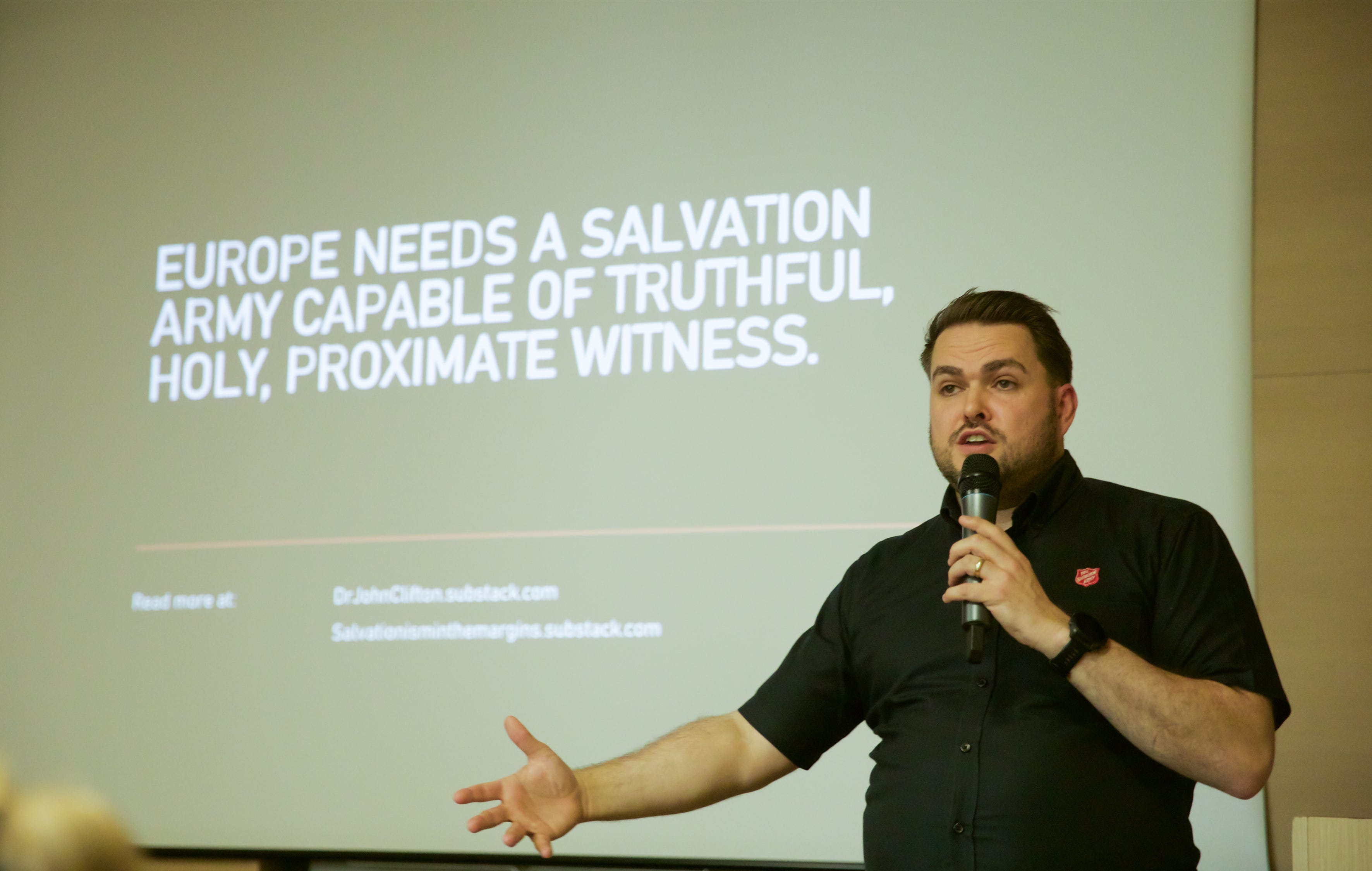
That is why our doctrine can speak legitimately, without embarrassment, of a “bias to the poor” – not because the poor are morally superior and not because hardship automatically sanctifies. But because Scripture trains the Church to expect Christ to be found among “the least of these”. If we lose that centre of gravity, we may still do impressive work—and build impressive narratives—but we will slowly lose our ability to recognise the Lord standing in front of us asking, “What about me?”
Now, here is where this becomes directly a communications question. The Salvation Army’s own teaching on power reminds us that power is inherently relational and that it must be exercised in love, justice, and mutual respect—because misuse of power erodes trust and weakens institutions. Communications is one of the ways we exercise power from within outwards. It determines whose voice is amplified, whose dignity is protected, what counts as credible, and what kind of neighbour we appear to be to the wider world.
It is also one of the ways that we, who in this moment embody an institution, shape the practices within the institution. What gets publicised gets reproduced in practice, and the practices we perpetuate shape who we become.
So I want to name this as plainly as I can: the practice of communications is a theological practice.
The stories we repeatedly tell do not merely describe our mission or raise funds; they disciple our instincts.
It must be understood to be so in a Salvationist context.
The stories we tell are not morally neutral. They can render people as clients, problems, beneficiaries, heroes, case studies—or neighbours. They can make the Salvation Army sound like an efficient NGO with a Christian origin story or like holy people whose service is an expression of God’s saving presence.
And they can do something else too: they can either protect the institution from discomfort—or they can disclose where Christ is already at work and where we are being called to repentance, proximity, and courage.
That is why the question “whose side are you on?” is finally not answered by our statements. It is answered by our moral location—by where we are willing to stand and whether our presence there is holy.
Which brings me to what I think is the central danger for us in Europe.
The danger is not that the Salvation Army will become “political” in some crude sense. The greater danger is that we will become merely useful: efficient, trusted by governments, publicly legible, morally respectable—and theologically thinned out; competent at services and branding, yet uncertain about accompaniment, spiritual distinctiveness, prophetic truthfulness, and the agency of the people whose stories we tell.
Holy nearness to Christ in the world is the alternative.
It is the refusal to manage needs without sharing life. It is the discipline of staying close enough to be interrupted, contradicted, and inconvenienced—close enough to hear the question, “What about me?”—and staying spiritually alive enough to speak a word of salvation and hope.
Toward a Salvationist Framework of Moral Location
So here is the proposal I want to place in your hands: the question “Whose side is the Salvation Army on?” should be translated into “What is the moral location of Salvationism in Europe?” Moral location is not party preference. It is where we stand and how we are seen to stand. It is whether our speech is formed by shared life and whether our stories reveal Christ among “the least of these” rather than merely displaying organisational virtue.
I find it helpful to test that moral location with five questions:
● Presence: Are we close enough to people and places of abandonment that we are formed by shared life rather than observation from above?
● Agency: Do our stories allow those most affected by hardship to appear as subjects, contributors, and companions rather than as passive recipients?
● Truthfulness: Do we name the deeper social and spiritual conditions shaping suffering, or do we only showcase outputs and interventions?
● Non-neutral witness: Do we act “without discrimination” while still allowing Christ’s preferential concern for the poor and excluded to determine our centre of gravity?
● Christological discernment: Do our communications help people recognise where Christ is present and at work now—especially among “the least of these”?
If you want a handful of short lines to carry in your pocket as you work, keep these close: “scrutinise the signs of the times”; “not called to be useful… but to be the embodiment of love”; and, from Matthew 25, “You did it to me.” They are small phrases, but they are weight-bearing.
And the tensions are real.
We must resist becoming partisan to a political party, but we can absolutely be partisan to Jesus.
We must refuse manipulative sentimentality, but we must not become afraid of compassion.
We must pursue excellence, but never at the price of holiness.
And we must never assume that better messaging alone can fix what is a crisis of presence.
Which brings us, inevitably, to the craft we have gathered to think about today: the stories we tell and what those stories do to the people within them.
If Salvationist witness is holy nearness, then our communications must sound like witness—not like reputation management—and remain close enough to real lives that our words cannot float free of truth.
Storytelling is Never Neutral
Salvationism has never been a purely indoor faith.
At its best, it is a public form of Christianity—visible, interruptible, and accountable—because it believes Christ is met in public, among people who are bruised, overlooked, and exposed.
That is why one line from our own historical grammar still feels like a command rather than a memory: the Salvation Army officer “goes down into the street”. Descent, not distance. Nearness, not management. Presence, not performance.
And if that is our instinct in the street, it must also become our instinct in media. Because communications is never a neutral wrapper around mission. It is already a theological act: it tells the truth or it performs; it witnesses or it brands; it honours people or it uses them.
So something we can say with certainty is that storytelling is never neutral.
This is important to return to because institutions—including Christian ones—can slide into telling stories in which people become props for credibility. We speak about those who suffer; we speak for them; we borrow their pain as proof of our relevance. But a faithful witness learns to speak with people and—where it is safe and appropriate—to let stories emerge from among them.
I have shared the five questions above, but I wonder now if there are eight distinctive marks of a Salvationist public witness. I want to speak to them not as a checklist but as a kind of rule-of-life for communicators.
1. Incarnational proximity: we go to the street, the room, and the public square.
2. Holiness made public: credibility comes from sanctified character, not polish.
3. Evangelistic compassion: mercy and proclamation belong together.
4. Testimonial truthfulness: first-person witness is a serious form of public theology.
5. Visibility with the marginalised: public presence signals solidarity, not superiority.
6. Practical mercy joined to moral appeal: relief without silence about exploitation and sin.
7. Internationalism with local rootedness: one movement, many neighbourhoods.
8. Hope enacted before it is explained: the gospel is often first met as a deed, a visit, or a listening presence.
If those marks are true, then the communications implications are not subtle. We will foreground stories of presence more than stories of institutional success: the corps in a hard place, the soldier who is known by name, the volunteer who listens, the chaplain who stays, and the neighbour whose testimony contains both struggle and grace.
And we must carry internal correctives close to hand: Salvationism needs saving—again and again—from spectacle without solidarity, branding without holiness, publicity without truthfulness, compassion without evangelism, evangelism without compassion, and the sentimentalising of poverty.
In a digital culture that rewards speed, outrage, and performance, this is countercultural. Salvationist communications should become “open-air” in character: visible but not tribal; invitational but not manipulative; courageous but not cruel; truthful rather than glossy; and grounded in local, embodied accountability rather than floating free as institutional messaging.
So here is the shortest theological answer I know to the question we began with. The Salvation Army is on Christ’s side—and therefore on the side of those among whom Christ chooses to be met in public.
the poor,
the ashamed,
the lonely,
the addicted,
the displaced,
the distrusted,
the deindustrialised, and
the spiritually hungry.
We stand there not by partisan capture or institutional self-excuse, but by holy nearness, practical mercy, truthful testimony, and an open invitation to salvation.
And if that is where we stand, then the final question becomes personal: not only “Whose side are we on?” but “Who is on the Lord’s side?”
“Who is on the Lord’s Side?”
We have moved through politics, legitimacy, institutions, and communications.
But now I want to bring it home to something more searching. Because before “Whose side are you on?” is a question anyone asks the Salvation Army, it is a question the Lord asks of us.
Not first as a question about our public positioning but as a question about our inward allegiance. About holiness. About whether we will choose holy nearness over safe distance—presence over performance—truth over polish.
Because if we are on Christ’s side, then we will find ourselves—again and again—where Christ chooses to be met in public. And our communications will not be merely the announcement of our virtue but as witness: truthful testimony, practical mercy, and an open invitation to salvation.
So…
“Whose Side Is The Salvation Army On?”
“We are on the Lord’s side; Saviour, we are Thine.”
Captain John Clifton is a Salvation Army officer, ordained minister, and theologian based in North Shields, North East England. He serves as the Divisional Commander for The Salvation Army’s North East Division, overseeing operations across the region, focusing on spiritual guidance, community outreach, and social services. His work emphasises the church’s engagement in public life and society, particularly supporting communities affected by debt, hunger, homelessness, and unemployment. His writing can be found on his Substack, With Christ in the Margins.
The talk is available on YouTube below.
This talk was first published on both of John Clifton’s two Substacks - the full text is on Salvationism in the Margins, and a shorter version can be found on Christ in the Margins. The full lecture above is reproduced here with the kind permission of the author.