


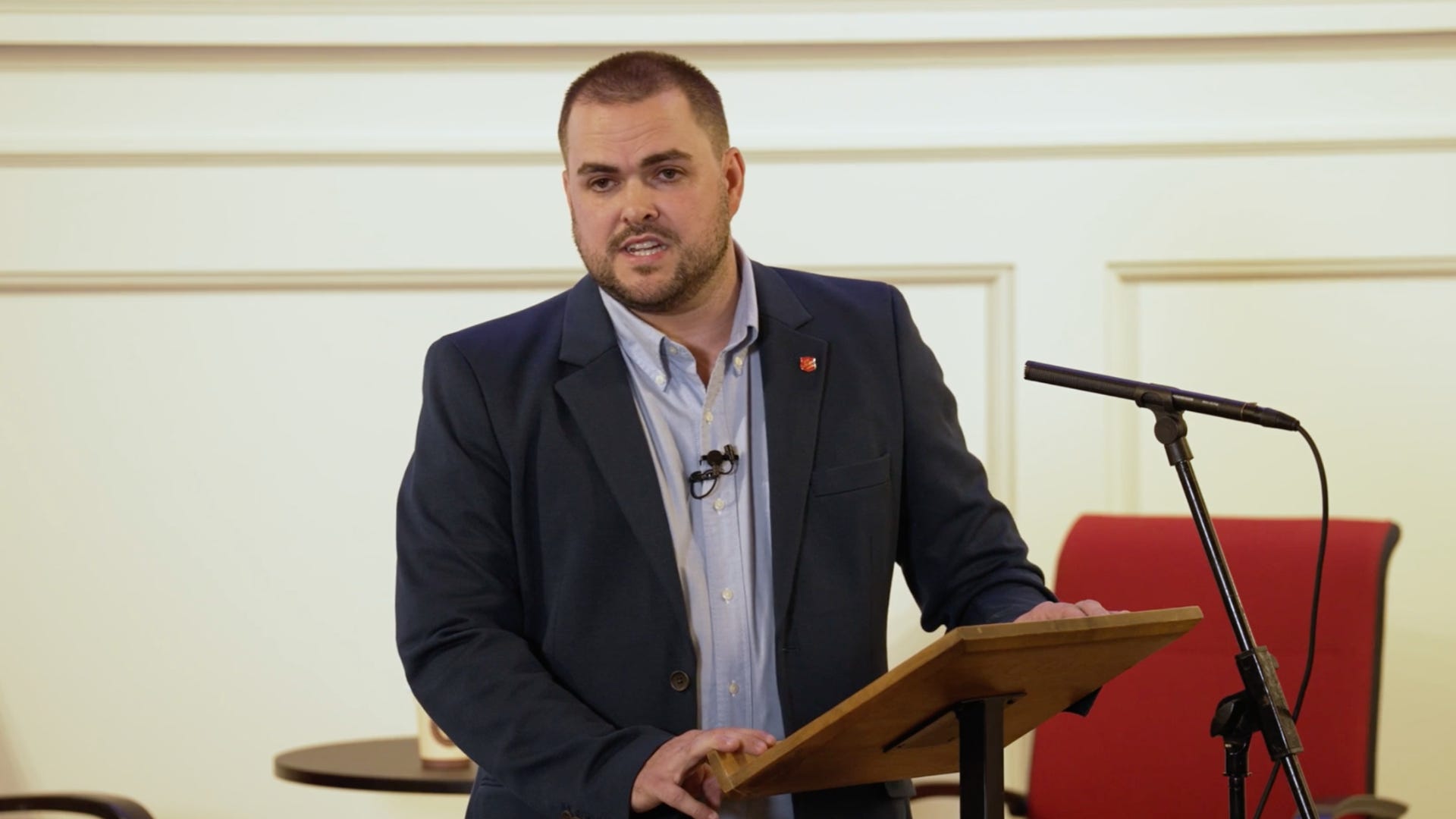
In this lecture, the sixth in our Staying Human series, John Clifton explores how globalisation has changed not only our economy, but how we treat people and places. Drawing on encounters in deindustrialised communities and signs of spiritual hunger in places where institutional Christianity has thinned, he argues for a return to proximity alongside forgotten communities, and for a way of following Christ that recognises His presence in the margins, chooses humanising solidarity instead.
This lecture was given before an invited audience of Christian leaders in London on 13 October 2026. Discover the rest of the series here.
Watch the video of this lecture here.
Download the text as a pdf here.
There is a house on Adeline Street in Goole, Yorkshire - number 32.
Almost a century ago, my grandfather, Albert Clifton, lived there as a boy.
One day there was a knock at the front door.
Albert’s mother answered it and found Adjutant Tuffin, the local Salvation Army officer, standing outside.
He announced, with the sort of ambition that Salvation Army officers occasionally experience:
“I’m looking for 500 children to start a Salvation Army Sunday school.”
Albert was summoned into the room. Tuffin invited the family to The Salvation Army and then continued along Adeline Street, knocking on other doors.
Not long after, there was another knock.
This time at the back door.
It was the milkman.
He had heard about the officer’s visit.
“I belong to The Salvation Army too,” he said. “My son will come and collect your son and get him to the Sunday school.”
An officer at the front door.
A milkman at the back.
A Salvation Army pincer movement.
And it worked.
Albert went. His mother began attending. Eventually his father, Ernest, did too.
Ernest worked at the docks. He eventually became the corps sergeant-major — the senior local lay leader of that Salvation Army congregation. On Sunday evenings he would lead the march back through the streets after the open-air meeting, watched by some of the same men he supervised during the week.
He used to say:
“They watch me more closely than they do the local Anglican vicar.”
1. Sent Somewhere
Recently I’ve begun to notice something else about that family story. Adjutant Tuffin had been sent to Goole; the milkman belonged to Goole. One went looking for 500 children. The other knew this child, in this house, on this street. Together they formed a chain of relationships through which a family encountered Christ and a Christian community.
David Goodhart’s contested distinction between “Anywheres” and “Somewheres” captures something useful here. Some of us — myself included — have lives shaped by mobility: education, institutions, successive places. Christianity is a faith of sending. But there is a danger in being an Anywhere sent Somewhere: we can arrive without learning, or having sufficient empathy, to pay attention.
Last year The Salvation Army sent my wife and me to the North East of England. I have increasingly realised that being responsible for a place is not the same thing as knowing it. You can know its statistics, deprivation, voting patterns and demographics and still not know its streets, what people love, what has disappeared or what remains.
So one discipline I have adopted is simply to walk the communities in which The Salvation Army serves with people who live there. Walking does not turn an incomer into a local, but attention is a discipline required of anybody sent somewhere. Those of us who arrive at the front door need to learn from the people who already know the way to the back.
2. Places Written Out of the Future
And paying attention in this way began to expose a recurring question that will run through everything I want to say this evening: who gets to decide the future of a place, who possesses the power to make that future possible, and what happens to people when that power lies somewhere else?
In some of the former mining communities of County Durham, that question has a remarkable history. It is captured in a single administrative classification: Category D.
Under the national planning framework established by the Town and Country Planning Act 1947, Durham County Council’s 1951 development plan classified villages according to their anticipated futures. Category D meant substantial population decline was expected. The consequences were concrete: no more capital investment; replacement housing was to be provided elsewhere; spending on services reflected the settlement’s anticipated remaining life. The original plan placed 114 settlements in Category D; the 1964 revision increased this to 121. The policy ended in 1977 after years of opposition. Many villages survived, often after decades of restricted development and investment.
The planners faced real problems — poor housing, declining pits and limited resources — and Category D was not simply an instruction to demolish villages. What happened was subtler. Someone had looked at this village, these streets, these homes, and made an administrative judgement about their future:
the future lies somewhere else.
Those making that judgement could organise investment, housing and infrastructure accordingly. The prediction did not merely anticipate decline; planning decisions organised around it helped produce the future it predicted.
One of the places I have visited is Langley Moor, just outside Durham, where The Salvation Army is still present. Langley Moor was designated Category D. One resident remembers growing up believing the “D” stood for “demolition”. Their mother refused to leave. Her family and friends were there; she worked there, shopped there, sent her children to school there. And rather than accept rehousing in neighbouring Brandon, the family moved from one deteriorating house in Langley Moor to another. The houses were failing. Her attachment to the place was not.
Another resident, Enid, remembered High Street North being demolished, from a shop up to the Salvation Army building. As the houses came down, their interiors were exposed to the street: wallpaper still clinging to walls, allotments visible through the gaps, domestic life opened to the rubble. She said it looked like a scene from the war.
There were genuine problems with the housing, and some residents accepted new homes elsewhere. But the memories also show that the classification did not exhaust what Langley Moor meant to its inhabitants. The planners saw housing and projected population decline but residents saw the place to which they belonged — and questioned who should decide its future.
This is where Giorgio Agamben gives us a useful concept. He calls an apparatus those mechanisms through which human life is captured, ordered and organised: institutions, classifications, administrative procedures, forms of knowledge and systems of government. Category D did not merely describe reality; through forecasts, planning permissions, housing decisions and investment priorities, it organised what could happen next. The classification acquired power over the thing it classified.
These villages were not outside the political order but thoroughly incorporated within it: surveyed, classified, planned and administered. Residents remained citizens who could organise and protest, and many did. Now, I am not suggesting an Agambenian state of exception, still less bare life. Something more ordinary was happening: they were governed as places whose future lay elsewhere.
Yet the experience of these communities was understood in terms far more profound than administrative inconvenience. One oral-history account describes relocation as being sent to “the reservation”, deliberately replicating language used for displacing Native Americans. On one of my own walkabouts, someone even spoke of the policy and impact as a form of “cultural genocide”. Such language tells us something about the depth of rupture people experienced.
Geographers Rachel Pain and Caitlin Cahill have examined the experience through the concept of slow violence: the cumulative destruction of the conditions through which communities sustain themselves. What was being dismantled was a particular way of belonging together.
The mine might have become economically obsolete. But who had the authority to declare that the community built around it had become obsolete too?
Category D matters to me as a paradigm — in Agamben’s sense, a particular case through which a wider operation of power becomes intelligible. Not because every history that follows is the same, but because it exposes a recurring structure: some possess the capacity to determine which futures remain possible while others live with the consequences. Category D gave that power a name and a letter. This is what I mean by being “written out of the future”.
3. When the Future Is Done to You
Category D eventually disappeared as policy, but its question did not.
I recently walked around Horden, in County Durham, which became famous for houses being sold for £1. Some streets remain visibly scarred: derelict terraces, false doors and windows covering empty properties. I walked with a local man who had graduated from university while continuing to live there, yet had been unable to find work for four years. Category D has disappeared. Its question felt remarkably contemporary: what future is available to somebody who belongs to this place?
And here I want to widen the lens from County Durham to the North East more broadly. In 1980 the Consett steelworks closed, costing some 3,700 jobs. The miners’ strike of 1984–85 was followed by further pit closures across the Durham and Northumberland coalfields; and by 1993 the Durham coalfield’s last deep mine at Wearmouth had its final shift. Sunderland lost its remaining major shipbuilding yards in 1988. On Teesside, ICI’s chemical complexes at Billingham and Wilton underwent successive rounds of rationalisation and job losses, while steel and heavy engineering also contracted.
These were distinct histories, not one story of abandonment. But they unfolded within a wider transformation of the British economy: liberalised trade and capital, technological change, corporate restructuring and deliberate policy choices exposed industrial communities to global competition while making capital more mobile. The crucial asymmetry was that people and places formed around those industries could not become equally mobile. Work sustaining households, institutions and ways of life was dismantled or reorganised, often through decisions taken far beyond the communities bearing their consequences.
Nor is this only a North Eastern history. Different versions of it can be traced through the former coalfields of Yorkshire, industrial communities across Lancashire and the Midlands, and places whose economic foundations were quite different. Blackpool, where I served before coming to the North East, was shaped by the long restructuring of the British seaside economy. The histories differ. What connects them is a recurring question about power:
who possesses the capacity to determine what economic changes happen to a place, and how much agency do the people who live there possess over the future that follows?
We should therefore expect such histories to have political consequences. In 2016, 58 per cent of voters across the North East voted to leave the European Union, including 57.5 per cent in County Durham. In 2025, Reform UK won 65 of 98 seats on Durham County Council and 23 of 69 in Northumberland. Then in May 2026, it won council majorities in Sunderland, Gateshead and South Tyneside, alongside 24 seats in Newcastle and all 12 seats contested in Hartlepool.
These were different elections, and voters had different motivations; Category D did not somehow cause Brexit or a later Reform vote. But Luke Telford and Jonathan Wistow’s research with working-class Brexit voters on Teesside found political decisions embedded in deindustrialisation, social dislocation and political abandonment, including a sense that historically representative parties had ceased to speak for them.
Capital can move. Communities cannot move so easily. Production can be transferred; investment can cross a border. But a house is here. A family is here. Memory and friendship are here. The grave in which your father is buried is here. The war memorial that your family is named on, and ancestors paid public subscription to build, is here.
The deepest issue, then, is not that some communities have failed to keep pace with the future, but that they have been written out of it.
That is a political condition: powerlessness.
4. Where Is Christ in This?
But I am not principally interested this evening in offering a better sociological description of post-industrial Britain. My questions are primarily theological.
Who is Jesus Christ in relation to the human being acted upon by powers they cannot control?
Where might Christ be encountered?
And what kind of social body does that encounter call into existence?
My argument is that Jesus Christ is the crucified, risen and ascended one who draws near to those rendered powerless, sends his followers into that same proximity, and makes himself encounterable there. The Church therefore does not simply take Christ to people and places that have been abandoned or written out of the future, but draws near expecting that Christ may already be there to meet us.
This, in this context, is what it means to stay human: to resist the tendency of political, economic — and ecclesial — apparatuses to allow their categories to become more real than the particular people they govern. Christianity’s answer to abstraction is radically Christological. God does not save humanity as an abstraction. God becomes this human being: Jesus Christ.
I will explore that claim as a Salvationist theologian in constructive conversation with Catholic Social Teaching and the Franciscan tradition. Their differences are part of what makes the conversation productive.
5. Two Traditions, One Social Question
Before bringing those resources together, let me take you to London in 1889.
Thousands of dockworkers were on strike. Their demand became famous: the “dockers’ tanner” — sixpence an hour. As the strike continued, the immediate question was brutally practical. How long could men remain on strike if their families could not eat?
Two Christian responses entered that struggle in different ways.
Cardinal Manning, by then in his eighties, became personally involved in negotiations between the dockworkers and their employers. William Booth and The Salvation Army came at the crisis from another direction. Salvationists fed striking workers and their families; Salvationists in Australia even raised money for the strike fund.
A meal could not settle an industrial dispute, but if a family could eat for another day, a docker could remain on strike for another day. Compassion had entered a relationship of power.
These were not sealed Christian worlds. Manning had publicly engaged The Salvation Army since 1882; Booth and Manning exchanged their major social writings.
And moving between these worlds was one of the more extraordinary figures of late-Victorian Britain: the journalist W. T. Stead.
Stead had worked closely with The Salvation Army during the 1885 Maiden Tribute campaign, which was successful in raising the age of consent in England. By 1890 he was a major influence upon — and substantial ghost-writer of — In Darkest England. Close to Manning, he travelled to Rome in 1889 hoping to encourage papal engagement with the social question.
Stead began imagining what he called a “Civic Church”: not another denomination, but Christians and other moral actors working across institutional boundaries for the transformation of particular places. Christian unity discovered not only by agreeing together, but by acting together - almost a proto-form of community organising.
Now watch the sequence.
1889: the Great Dock Strike.
1890: Booth publishes In Darkest England.
1891: Leo XIII publishes Rerum Novarum.
I am not suggesting a line of influence from Booth to Rerum Novarum; I can find no evidence for one. What we can see are overlapping Christian networks grappling with the same social question. Manning stood within the Catholic social world around Leo’s engagement with labour; Stead moved between Catholic and Salvationist networks and became an early interpreter of Rerum Novarum; Booth’s relationship with organised labour continued.
The documents were profoundly different. In Darkest England grew from Salvationist engagement with hunger, homelessness and unemployment; Rerum Novarum addressed capital and labour, property, wages, workers’ associations and public authority.
But both were wrestling with the question that has been following us from County Durham: what does Christian faith require when human beings are acted upon by economic powers they possess little capacity to act upon in return?
Catholic Christianity possesses a profoundly sacramental imagination. At its centre stands the Eucharist: material things through which the Church encounters Christ’s real presence. Eucharistic communion creates ecclesial communion with social consequences.
Salvationism presents a different puzzle. Within decades of its birth The Salvation Army had ceased to observe baptism or the Lord’s Supper, yet became extraordinarily material: bodies, food, clothing, housing, work, streets and homes.
What happens to sacramentality when a Christian tradition removes sacramental ritual from the centre of its common life? Matthew 25 offers one answer. Christ identifies himself with the person encountered in compassionate action: “You did it to me.” This grounds an argument I continue to develop: embodied compassionate encounter can itself be understood sacramentally — a material location in which Christ makes himself present and encounterable.
Catholicism moves, we might say, from Christ encountered at the altar towards the social body; Salvationism from the neighbour towards Christ. The differences remain real, but they invite constructive conversation.
And here I want to introduce a third voice: the Franciscan tradition.
In his Testament, Francis remembers his encounter with lepers as decisive in his conversion. What had seemed bitter became sweet when the Lord led him among them and he showed mercy. Francis draws near — and Francis himself is changed.
Christian social action can run in one direction: somebody possesses food, money, knowledge or institutional power; somebody else lacks it. Francis’s encounter is more disruptive. The apparently powerless person is not simply an object of benevolence but part of Francis’s conversion. Matthew 25 intensifies the claim: the neighbour becomes a place of Christian disclosure. We go imagining we take Christ with us and discover Christ meeting us there.
That changes the direction of mission. The Church has something to give, but also something to receive.
Franciscan fraternity insists that compassion cannot end in a permanent relationship between benefactor and beneficiary. Its destination is communion: “the poor”, “the leper”, “the service user” becomes brother or sister.
6. The Particular Against the Apparatus
Franciscan practice has brought us to the irreducibility of the person before us. And here Franciscan practice opens onto Franciscan theology. A generation after Francis, John Duns Scotus developed a sophisticated account of what it means for something to be this particular thing.
This is why I have treated Category D as a paradigm: the particular case makes a wider operation of power visible.
Agamben and Scotus are not entirely separate conversation partners here. In The Coming Community, Agamben engages Scotus’s account of haecceity as he develops his own understanding of singularity. They have differences, but both resist reducing the particular to an instance of a general category. Agamben helps us see what the particular case discloses about power; Scotus helps us ask what it means that the one upon whom power acts is this particular creature.
Scotus’s question was metaphysical, not political: what makes an individual this individual rather than another instance of a common nature? His answer involves what was subsequently described as haecceitas (hek-see-a-tee) — thisness. I am appropriating that constructively, not claiming, obviously, that Scotus was writing a social theology of post-industrial County Durham!
An apparatus necessarily deals in categories: Category D, C2DE, migrant, Muslim, service user. Categories can be necessary and can expose injustice. The danger comes when the category becomes more real than the particular person. Nobody actually lives in “Category D”; they live in this village.
Here Scotus’s particularity intersects with a distinctively Franciscan Christological claim. For Scotus, the Incarnation is not merely God’s emergency response to sin; Christ belongs at the centre of God’s intention for creation. Christianity does not finally proclaim that God affirmed “humanity”, but proclaims that the Word became flesh: God became this human being, Jesus of Nazareth.
The apparatus moves towards abstraction because abstraction makes human life governable. Christianity moves towards particularity because God himself has done so. Categories remain necessary, but cannot have the final word. At the centre of Christian faith stands the irreducibly particular human being Jesus Christ.
Christianity then tells us what happened to this particular human being. He was acted upon by the powers: arrested, judged, stripped, mocked and executed.
Paul writes in Ephesians that our struggle is not simply “against flesh and blood”, but against rulers, authorities and powers. That need not remove responsibility from human actors. The powers become materially visible through institutions, judgements and arrangements by which some acquire the capacity to determine the futures of others.
At the Cross those powers converge upon a particular human body: political and religious authority, imperial violence. Together they pronounce an apparently final judgement upon Jesus of Nazareth:
This man has no future.
Christianity, then, makes its extraordinary claim precisely there:
The crucified one is raised.
Resurrection is God’s contradiction of the judgement pronounced upon Jesus by the powers. The authorities possessed sufficient power to arrest, condemn and kill him. What they did not possess was final authority over his future. The Christian story centres upon a man whom the powers wrote out of the future — and whom God raised from the dead.
7. Holy Nearness
What kind of social relationships, then, become appropriate to human beings in whom this Christ has told us we may encounter him?
If the powers do not possess final authority over the human person, Christian social thought must ask what relationships and institutions correspond to that claim. Catholic Social Teaching offers a grammar: dignity, solidarity, subsidiarity, participation, the dignity of work and the common good. I approach it through Pope Francis’s Fratelli tutti.
Francis insists fraternity does not require placelessness: “There can be no dialogue with ‘others’ without a sense of our own identity.” Genuine openness includes love for land, people and cultural roots without turning them into idols. Nor does openness require detachment from somewhere.
What he offers is rooted openness: I stand somewhere, and therefore can encounter someone who stands somewhere else. A Category D village was a web of memories, obligations, neighbours, institutions, graves and stories. Rootedness should enable encounter, not prevent it.
Yet fraternity cannot remain kindness towards people whose lives are being determined elsewhere. In paragraph 164 Francis moves from interpersonal charity towards political love: love for another must concern itself with the social conditions within which that person’s life becomes possible.
That takes us back to Manning, Booth and the dockers. Feeding the dockers did more than relieve suffering: in those circumstances it helped preserve their capacity to act.
Here solidarity meets subsidiarity and participation. Solidarity refuses abandonment; subsidiarity refuses to confiscate another’s agency; participation insists that people have a meaningful part in shaping the common life whose consequences they bear.
Franciscan fraternity says: this person is my brother or sister. Catholic Social Teaching asks what social order is appropriate between brothers and sisters. Salvationism asks something characteristically practical: how close would we have to get before we actually became neighbours?
I call this holy nearness.
Holy nearness is the disciplined refusal of abstraction: drawing near enough that people cease to be objects of our categories and become persons with whom we share life, act, and may encounter Christ.
But holy nearness becomes interesting only when it becomes difficult — where our political and cultural categories are strongest.
“The Muslim”, “migration”, “the white working class”, “the Reform voter”, “the nationalist”, “the far right”: these categories may name real phenomena, but they can become more real to us than the people they describe.
Questions about immigration, integration, Islam, demographic change and national identity are questions about the common life. If people should possess meaningful agency over economic changes that reshape their communities, we cannot declare cultural and demographic changes beyond legitimate democratic concern. Their pace, scale and consequences are proper matters for political judgement. That gives no community a right to remain unchanged. But neither can disagreement simply be psychologised as fear, anxiety, ignorance or prejudice. Fratelli tutti’s rooted openness does not require cultural amnesia.
I have encountered both sides of that problem in ministry. In Ilford, east London, Urdu was sometimes more useful than English along Ilford Lane; I understood a little myself from five teenage years in Pakistan. We met Pakistani grandmothers who wanted to learn English so they could read the books their grandchildren brought home from school. Some had lived in England longer than I had been alive; their grandchildren were third generation and spoke primarily English. Their desire was beautiful, but it should trouble us that people could live here for decades without needing the country’s common language.
That is not simply individual failure. What kind of approach to immigration and multiculturalism permits demographic transformation while paying so little attention to the institutions, relationships and language through which shared life is built? Our modest response was to help run English conversation clubs. Proximity complicated the category: these were not ‘migrants’ or ‘Muslims’, but grandmothers. A common language enlarges the relationships in which we can participate.
Blackpool taught me something complementary. When asylum seekers were placed in hotels there, I raised serious concerns with local and national government about placing significant numbers of people into one of the most prominent hotels in one of England’s most deprived towns. Hospitality does not require pretending that place, capacity and the common good do not matter.
But the people placed there were now our neighbours. We challenged the policy and served the people. We organised clothing provision for asylum seekers in a way that also increased our capacity to provide clothing for local people in poverty. The choice between loving the newcomer and loving the people already there was a false one. We could question the decision that brought someone to our town without making that person bear the moral weight of the decision.
Particularity requires relationship, and relationship takes time. Where change happens faster than institutions can build relationships across difference, people can remain categories to one another rather than becoming neighbours.
The Church is not immune. We can speak particularly about migrants and Muslims while describing sections of the white working class almost entirely through political categories. Those categories may name things requiring Christian criticism, but naming an ideology is not the same as knowing a person.
Holy nearness asks whether the Muslim has become an enemy before becoming a neighbour, or the angry working-class protester a political problem before becoming one. Proximity does not abolish disagreement; sometimes it sharpens it. But it makes judgement answerable to encounter.
The ecclesial question is whether the Church can become a body in which strangers acquire the relationships through which they can meet, disagree, act and belong together.
8. What Kind of Body Does This Christ Call Into Existence?
Holy nearness cannot remain an individual ethic; it must become a form of common life. The New Testament’s answer is audacious: the Church is the Body of Christ. People who would not otherwise belong are drawn into common life because they have been encountered by Christ.
Think of Saul on the road to Damascus. Saul does not encounter a proposition, Christian values or a civilisational inheritance. He encounters a person.
“Who are you, Lord?”
“I am Jesus.”
This Jesus: crucified, risen, ascended.
Then Christ sends Saul to Ananias, and Ananias to Saul. Encounter with Christ does not dissolve human particularity; it creates new relationships between particular people.
Christianity’s universal claim does not escape the particularity of Jesus Christ. This Christ can encounter anyone: all can be redeemed, forgiven their sin, made holy and called as disciples.
Its universality is the universal availability of a particular Christ.
And people do not always begin reaching towards this Christ from places the institutional Church expects. We are seeing, for example, young men engage seriously with Christian apologetics through polemical encounters with Islam — at Speakers’ Corner, in classrooms, and online — acquiring surprising biblical and theological literacy outside the institutional Church.
We should not confuse apologetics with discipleship. Knowing how to defend the Trinity against a Muslim interlocutor is not the same as following the crucified Christ. But I worry that parts of the Church have become much better at diagnosing what is wrong with these young men than at recognising what might be beginning in them.
And perhaps the Church has something to learn from them too: a willingness to take religious truth-claims seriously. Christianity and Islam make profoundly different claims about God, revelation and, above all, Jesus Christ. An Eid Mubarak Facebook post or a smiling selfie at an iftar may be perfectly good expressions of friendship. But they are not a substitute for theological encounter. A surface peace which depends upon leaving our deepest differences unspoken is no deep peace at all. Holy nearness is not the abolition of truth in the name of relationship. It is the place where truth is spoken within relationship.
If somebody reaches towards Christianity through apologetic engagement with Islam, our task cannot simply be to correct his politics. It is to introduce him to Jesus Christ — and perhaps to allow his seriousness about truth to challenge us too.
This shapes the Church we become. The Muslim and the person reaching for Christianity to defend country, culture or inheritance - or even simply to find some sure ground in the midst of something they find suspicious - both need to encounter Jesus Christ. Neither simply needs to become more like “us”, who are already used to church life. Conversion to Christ is not conversion to the social and political culture of the existing Church. Becoming Christian does not require becoming middle class or inheriting the political preferences of those who discipled you. Christ, not a pre-existing political culture, is the criterion of Christian conversion.
Christ confronts, judges, forgives, reorders our loves and teaches us how to belong to one another.
This is what enables the Church to become genuinely catholic: people who would not otherwise belong to one another discover themselves called into one Body by the same Christ. But belonging to that Body must mean more than being welcomed into it. It must become participation.
Salvationism has an intensely embodied ecclesiology: we pray, testify, sing, serve, visit homes and stand in streets together. Yet even compassion can leave those we serve as clients or beneficiaries while we remain the actors.
Catholic Social Teaching’s insistence upon subsidiarity and participation presses us beyond that arrangement. The question is no longer simply, “What can we do for this community?” It becomes:
What can the people of this community become capable of doing together?
This is why broad-based community organising is so helpful. Its craft is not principally campaigning or mobilising but building relationships: one-to-ones, identifying leaders, organising across difference and developing people capable of common action.
Central to it is self-interest — not selfishness, but what people care about enough to act upon: children, street, congregation, work, safety, neighbours, home.
Where others have repeatedly defined people’s interests for them, agency begins when people name what matters, discover shared interests and build the relationships and power to act together.
It creates a movement from client to agent, from isolated grievance to relationship, from relationship to organisation, and from organisation to action.
But broad-based organising depends upon institutions capable of organising their own people, and in many places those institutions — churches included — have weakened. Thin, ageing congregations organised around delivering religious activity may have little capacity for common action.
Organising therefore has to reach into congregational renewal: rebuilding relationships, identifying leaders and forming people capable of acting together. It reminds the Church how to become an organised people itself.
And suddenly we are back in County Durham: who gets to participate in making the future of this place?
The Church cannot answer by becoming another service provider. It must become a people organised around Jesus Christ through whom relationships, responsibility, institutions and common action can be rebuilt — not chaplain to a disappearing social order, religious wing of a political tribe, or benevolent manager of powerlessness.
In places hollowed out by institutional withdrawal, the Church’s vocation includes helping rebuild the institutions through which common life becomes possible.
A Church socially distant from the powerless does not merely have a mission problem but a Christological problem.
If Christ has told us where he may be encountered, a Church which no longer knows those people may discover that there are things about Christ which it no longer knows.
9. The God Who Writes the Powerless Back into the Future
So let me return to County Durham: villages marked with a letter, whose anticipated future lay elsewhere. Christian hope does not romanticise what happened. Industries disappeared and ways of life were lost. Resurrection does not promise their return. Resurrection is not nostalgia.
Christianity’s foundational proclamation concerns a particular human being whom the powers wrote out of the future — and whom God raised from the dead.
The powers’ judgement is not God’s judgement.
Those who appear to control the future do not possess final authority over it. No economic assessment, demographic forecast, bureaucratic classification or political judgement can constitute God’s final judgement upon a human being.
The man whom the powers wrote out of the future is Lord.
Franciscan fraternity teaches us to receive the other as brother or sister. Catholic Social Teaching insists that they become participants in the common good, not objects of somebody else’s decisions. Salvationism calls us into holy nearness: close enough to share life, responsibility and action. Christ tells us why: “You did it to me.”
We draw near because Christ drew near. We refuse abstraction because Christ meets us in embodied persons. We restore agency because those we encounter are subjects, not objects. We refuse a Christianity defined merely by its enemies because Christ calls a people to follow him. And we refuse to write people and places out of the future because the crucified Christ has been raised.
Which takes me back to 32 Adeline Street.
Adjutant Tuffin wanted to reach five hundred children. It was an audacious ambition. But the Gospel did not reach my grandfather as one of five hundred. It reached Albert: this child, in this house, on this street.
And it reached him through relationship. An officer knocked at the front door. A milkman who knew the family came to the back. His son would accompany Albert to the Sunday school. And through Albert came his mother and then his father.
Perhaps Ernest is where the story becomes most interesting. He was a foreman on the docks. He became the corps sergeant-major — the senior local lay leader of that Salvation Army congregation. The same men who knew his leadership at work watched him lead The Salvation Army through their streets on Sunday.
The Church had not simply established a presence in Goole. Christian leadership had taken root within the working relationships of the place.
The five hundred mattered. But Christianity became concrete in the one.
And perhaps that is the strange movement at the heart of Christian faith. God loves the world, and so the Word becomes flesh: this human being, Jesus Christ. This Christ encounters Saul. This Christ identifies himself with the hungry, the stranger, the naked, the sick and the prisoner. This Christ gathers particular people into his Body and sends that Body into the world, not to love humanity at a safe distance, but to find neighbours.
Perhaps staying human begins there.
This child.
This house.
This street.
Close enough to one another that we might find Christ.
Captain Dr John Clifton serves as Divisional Leader for The Salvation Army in the North East of England, following fourteen years of local ministry in complex urban settings. Based in North Shields, John has led congregations through trauma, social breakdown and renewal, and brought those experiences into public life by engaging public institutions and political decision-makers locally and nationally through broad-based community organising. Across these settings, a key conviction has taken shape: Jesus Christ is most consistently encountered in the margins—within concrete lives, contested spaces, and costly encounters. John holds a PhD in Systematic Theology, lectures at the International College for Officers, and writes at Christ in the Margins.