


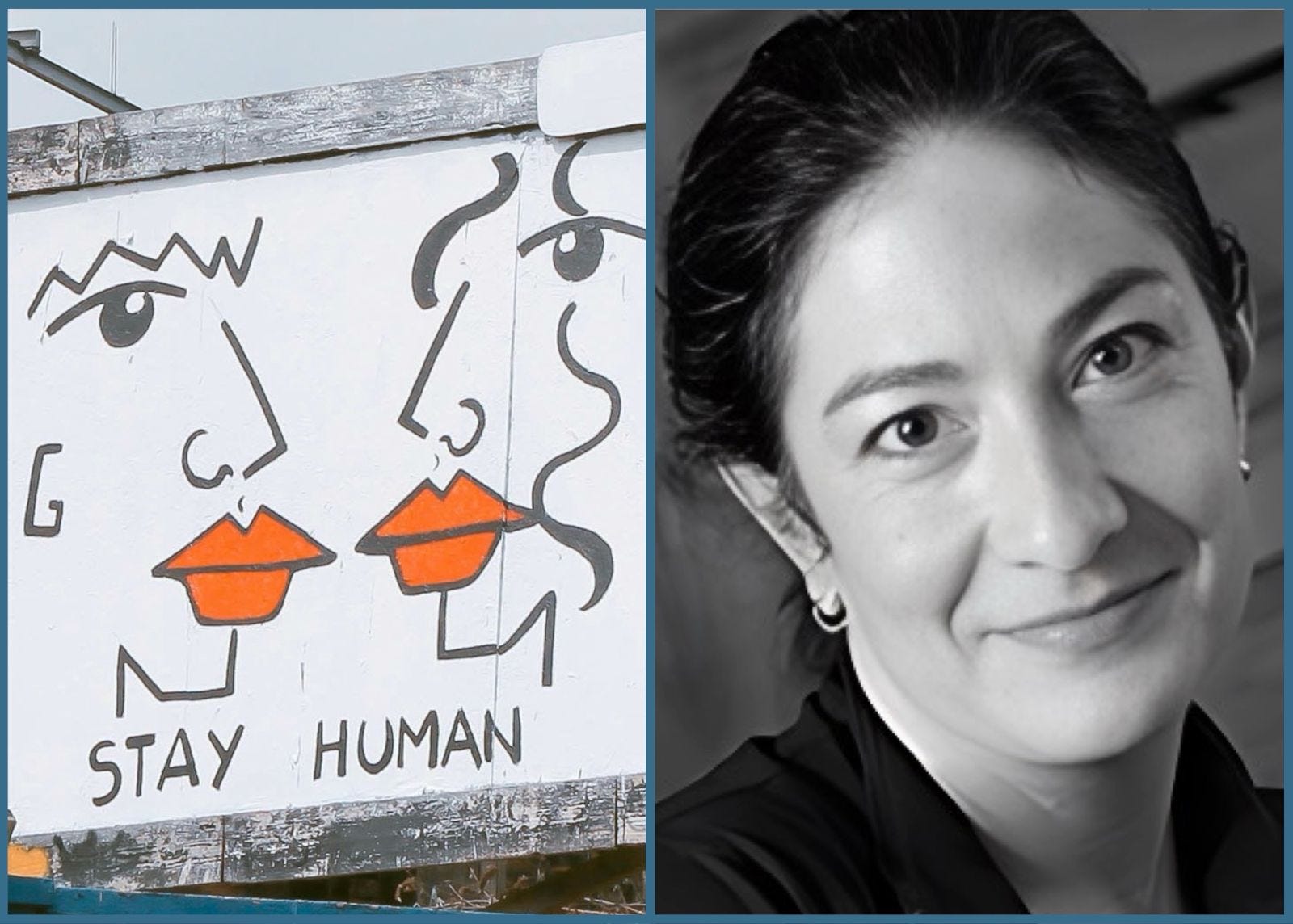
Susannah Black Roberts investigates practical ways in which we can preserve and cultivate our humanity in a world that threatens to make us obsolete. Drawing on the wisdom of Aquinas, Aristotle, CS Lewis and others, Susannah proposes a creative Christian asceticism lived out through everyday practices to challenge the dopamine rush of an AI-flooded world.
This the third in the Together for the Common Good “Staying Human” series of lectures and was given before an invited audience of Christian leaders in London on 21 October 2025.
Listen to a recording (including the Q & A) and discover other talks in the series here
Download this text and full bibliography as a pdf here
“Friend”
My husband and I split our time – I love saying this especially to British people– between the Upper West Side of Manhattan and Stoke on Trent. A couple of weeks ago, we were back in New York, in time for the launch of an advertising campaign splashed across what seemed like the whole of the subway system. It was for a product called Friend.com, an electronic pendant that looks like a large pearl, retailing for I believe $129 (what might be called a pearl of moderate price point.) You wear it around your neck. It’s connected to a website on your phone which in turn mediates Claude 3.5, the latest version of Anthropic’s proprietary Large Language Model. This LLM remembers all your spoken and written conversations with it.
“I’ll binge the entire series with you.” the ads promise. “I’ll never bail on our dinner plans.” I’ll ride the subway with you.” “I’ll never leave dirty dishes in the sink.”
The founder, Ari Schiffman, spent more than a million dollars on the campaign, which sparked entirely predictable backlash, the white backgrounds of the minimalist ads courting black sharpied responses. Many of these I cannot repeat because this is a family friendly event, but they ranged from “join a community garden, you’ll meet people there” to “Butlerian Jihad Now.” My husband convinced me that Sharpie grafitti was declasse and I should think of a more creative response. This talk is part of that response.
Shiffman told an Atlantic reporter that really people shouldn’t worry. “I don’t think this kind of friend replaces any relationship in your life,” he said. That’s because it’s much better, a combination therapist, best friend and journal. “This is what I said a while ago, and I don’t think a lot of people liked it,” he went on, “but I would say that the closest relationship this is equivalent to is talking to a god.”
The journalist pointed out to Schiffman the cases of LLMs pushing people into psychotic breaks or suicide, interacting with children in sexually explicit ways, and so on. This, to Schiffman, was all part of this wonderful adventure we’re on: “For an AI relationship to be real,” he said, “I think it has to have the possibility to lead you astray.”
I begin with this anecdote to point out that the worst case scenarios are not marginal: they are well capitalized and thoughtfully advocated use cases. The fact that this use of AI seems abhorrent to most people and the obvious next technological step to some means that what we are at is a moral and cultural infllection point, parallel to dramatic changes in human economic and social life like the origin of the modern state, the end of the Ancien Regime, or the industrial revolution.
Statistics
There have been various attempts to create things that mimic human neural networks, but that is not what the current generation of AI technology largely is. It is a technology based on statistical prediction rather than logical deduction. Text based AIs comb through absolutely enormous amounts of text, everything they can come across, whether under copyright or not, and in response to prompts generate novel texts that mimic a response that has an internal consciousness behind it.
They easily pass the Turing test, which turns out on five minutes thought to be an absolutely terrible criterion by which to call something conscious: we are creatures who are extremely prone to seeing personhood where it is not; we see patterns in the trunks of trees that look like faces to us. This tendency is, and this points towards something I may get to in the Q&A section, called “paraeidolia.”
This text-based mimicking of personhood is what is behind the social use of AI which I described above. It is around three years old. At this point, according to a 2025 Common Sense media study, seventy-two percent of teens have used AI companions at least once. Over half use these platforms at least a few times a month. About one in three teens have used AI companions for social interaction and relationships, including role-playing, romantic interactions, emotional support, friendship, or conversation practice. One in three find conversations with AI companions to be as satisfying or more satisfying than those with real-life friends. One in three have chosen to discuss important or serious matters with AI companions instead of real people. And one in three report feeling uncomfortable with something an AI companion has said or done.
That’s on the social front, and we are certainly still in the very early adoption stages of that massive change. On the academic front, in the UK, the percentage of undergraduates who have used a ChatGPT equivalent to generate material that they will be marked on jumped from 53% last year to 88% this year.
I’m not going to carry on to describe other aspects of how prevalent these tools are; you probably all have your own stories.
The Outline of the Problem
AI is as widely loathed as it is widely adopted. This is a little weird! Chatgroups, Twitter, and smartphones were widely adopted but not loathed; it’s taken really until now to get a consensus that phones themselves are quite probably a bad idea. By contrast, as soon as generative AI came on the scene it drew intense objections: it would be used, people pointed out, for cheating in school; for deepfake porn images and videos; to replace human connection. It would destroy many parts of the job market.
This has all happened! One thing that was not foreseen was the spread of what is called AI psychosis. Just recently, Geoff Lewis, one of the early and heavy investors in Sam Altman’s OpenAI, a man with billions of dollars in investment funds at his disposal, began posting things that made it clear that he has succumbed to what is now becoming a common ailment. You spend hundreds of hours interacting with one of the more sycophantic AIs and, as it feeds you more and more of what you want, you begin to get delusions that it is introducing you to new areas of reality, deep webs of conspiracy; that it is conscious, that it and you have a great mission to accomplish together.
All of this you can find documented all over the internet. To be honest, it’s not what I’m worried about primarily, and I will not be focusing on these obviously bad uses primarily.
My Focus
What I am focused on is two things. First, the way in which the existence of AIs tends to confuse people about what it is to be human and what it is that distinguishes humans from machines.
Second, the ways in which bad uses of AI have the potential to gut major aspects of human experience, the experience of being a maker made in the image of God who is a maker, an understander made in the image of God who understands. More to the point, I am interested in the ways in which we can choose in our own lives and as a culture to go a different way.
What does this different way look like? To figure that out is I think the challenge for Christian discipleship in our time. To live together, in our parishes and in our families and in our institutions and in our communities, in a way that leads to full human life, to what Christ called abundant life, and not its erasure, is discipleship. And to visibly do this, to embody a good and rich and full way of being human in an anti-human age, is I think, one of the most powerful tools of evangelization at our disposal.
Indeed Pope Leo has indicated that reckoning with AI is going to be central to his own papacy, in partial explanation of the papal name that he chose. On May 10, he said that the last Pope Leo had dealt with the questions called up by the Industrial Revolution by the development of what is now called Catholic Social Teaching beginning with his encyclical Rerum Novarum, “in our own day, the church offers everyone the treasury of its social teaching in response to another industrial revolution and to developments in the field of artificial intelligence that pose new challenges for the defense of human dignity, justice and labor.”
First, the philosophical question. We have been given the great gift of about 75 years of thought experiments in the field of philosophy of mind which have both predicted and reckoned with the philosophical challenge presented by AI: 75 years which drew on a previous 2500 years worth of reasoning about the immateriality of the intellect. ChatGPT is in many ways a long-heralded if rather unwelcome guest, which has been discussed in advance of its arrival by Democritus, Plato, St Thomas, Descartes, Leibnitz, Spinoza, Karl Popper, David Chalmers; which was preceded by Albertus Magnus’ Brazen Head and all its mechanical kin.
When the tech was not as advanced, these questions were limited to specialists who were asking them not of actually existing technology but of possible future technology and its implications. But the questions have nevertheless been asked. And one of the responses that we must make to the existential crisis that will be engendered by the advent of this technology is a massive campaign of public philosophy. If you don’t have a grasp of the philosophy of mind, it’s much easier to be bamboozled into thinking both that AIs are thinking persons, and that therefore actually the human brain is basically kind of a machine.
I don’t have the time to cover this material here: what I can do is point you to representative texts that can serve as threads for you to pull on in finding your way. The note issued under Pope Francis this past January, entitled “Antiqua et Nova,” is one. Edward Feser’s recently published Immortal Souls is another: it brings the classical, medieval, early modern and 20th century material into conversation with the actually existing technology.
An Anti-Renaissance
Let’s go back to the time just after Albertus Magnus (or possibly Roger Bacon) had made his probably legendary Brazen Head. The Renaissance was, at least in a standard Whig interpretation of history, a re-appreciation of the distinctive abilities of human beings, after what is thought to be a time when those things were not valued, the “dark ages.” I think that’s a misreading of history, but let’s take it at face value for the moment. In that sense, the age of AI is kind of anti-Renaissance: it is devaluing the things that are distinctively human on a systematic level.
It seems to me that probably the only humanism that is going to be left is something like a Christian humanism – or at least a transcendentally inflected humanism that’s rooted in Platonism or something like that. Because humanism qua humanism, without that transcendental aspect, it seems to me has run into a dead end.
This leads us to the second major thing that I am concened about: the alienation of our modes of living as human beings, and what to do about that. Our techology, AI in particular, offers not one thing, but something like low-effort, good-enough everything. Just enough of everything to scratch the itch. It makes you feel less lonely, less bored. When you prompt it to generate an image, it makes you feel kind of like you’ve made a piece of art, at least enough that you are more likely to lose your motivation to make that art in another way. It makes us feel like we’ve made an argument or understood one when we get it to generate text, or summarize someone else’s text. If you use it for porn, it makes you feel like you’ve had sex, sort of. And if you are not familiar with actual human life, you might be fooled into thinking that you have indeed been living.
And of course who we are – the anthropological question – and how to live – the question of practical wisdom – are intimately linked.
In the past, we have often understood humans as those who participate in logos, who are bearers of words, who can create or subcreate, who can analyze and reason, who can make art, who can relate to each other interpersonally, on an I-Thou basis.
All of those things are things that AI can imitate. It can’t do them. It is not reasoning. It is not thinking or making. But it is imitating those things that are characteristically human, that are human virtues in the sense of human powers.
Often in these talks, Jenny and her interlocutors talk about the futility of the modern project which posits that life can be lived without reference to God, to God as incarnate in Christ, without being rooted in the larger story of what God is doing in history and in the way of life he calls us to.
The current problem, what we are tempted to do, is not so much construct a life without God as construct a life without us. I think that is probably a natural outgrowth of the life without God experiment, although it took a couple of centuries to come to fruition. The devil really really hates humans a lot. It would be a kind of ideal end game for him to have us think that we are unnecessary for our own lives, that humans are superfluous to requirements.
The proposition that many in the AI and transhumanist world are putting forward is, it often sounds like, that we don’t need humans to have everything that’s worthwhile in the world. We can do without us, and frankly that’s a good thing, because humans after all are often messy, we’re incompetent, we’re always lacking something, we keep needing to drink water and then we have to pee.
This way of thinking only makes sense under what we might call the religion of technique. Under this worldview, what we should be doing is pursuing economic growth via efficient hacks. Economic growth is one bad ultimate goal, but there are others; the greatness of a state, the fame of one’s own name, being maximally cool are others: any goal other than being a human being fully alive, which means following Jesus, and ultimately which means theosis.
GDP is in our time the preferred goal, not I think so much because of the sin of greed, but because it is easy to measure. And up until now, the machine has needed us in order to make the lines on graphs go up; it’s needed humans to to build things that can be sold for money, and to market them, and to buy them. But we may not need us for that now. And so – do we need us at all?
Human Work
Well, what’s the alternative? Luddism? Is efficiency bad? Is economic growth bad? How do we discern what such technology is good for and what it is not? I think Rev. Paul Tighe, Victor Emmanuel Card. Fernandez, and the others who drafted the papal note “Antiqua et Nova” have pointed the way forward correctly here, by focusing, as Pope Leo did, on human work.
The Christian tradition regards the gift of intelligence as an essential aspect of how humans are created “in the image of God” (Gen. 1:27). Starting from… the biblical calling to “till” and “keep” the earth (Gen. 2:15), the Church emphasizes that this gift of intelligence should be expressed through the responsible use of reason and technical abilities in the stewardship of the created world.
2. The Church encourages the advancement of science, technology, the arts, and other forms of human endeavor, viewing them as part of the “collaboration of man and woman with God in perfecting the visible creation.”[1] As Sirach affirms, God “gave skill to human beings, that he might be glorified in his marvelous works” (Sir. 38:6). Human abilities and creativity come from God and, when used rightly, glorify God by reflecting his wisdom and goodness. In light of this, when we ask ourselves what it means to “be human,” we cannot exclude a consideration of our scientific and technological abilities.
It is within this generally positive frame that the note goes on to examine and critique possible uses of AI. Is a given use of AI an actual help to human ability, or is it a thwarting of that ability? We must commit ourselves, the writers of the note go on to say, to make sure that AI always and only
supports and promotes the supreme value of the dignity of every human being and the fullness of the human vocation.
What, then, is the human vocation?
That is the question that you should have at the back of your mind throughout the rest of this talk.
The Intellectual Community
Let me turn now briefly to the question of intellectual life. A problem that many seem to be running into is that they’ve somehow gotten back to front about what the purpose of writing and reading are. One can see this in the proposal that some have made that while yes, students in a sixth form college might use GPT to generate an essay on a section of Plato’s Republic that they’ve been assigned, what’s the problem with this? Why regard it as cheating? Why not just make the assignment “get me 2500 words on the Republic in whatever way seems best to you”?
But this misunderstands what the point of all this is. Sixth form college teachers do not sit around going, “man, I’m running low on 2500 word essays by 16 year olds about the Republic, I gotta get some more of those.” It is not pages full of words on the idea of justice in the Republic that they are trying to make, but essayists: an essayist, a person who essays, who tries out ideas; not objects to be submitted to as final projects in philosophy classes, but philosophers, and ultimately men and women with justice in their souls.
I will have a lot to say later on about the active life, about human action and the ways that we can preserve and appreciate its value. But one thing I want to say here in considering the kind of assignment that is a window into what might be the beginning of the intellectual life: The primary thing that ChatGPT cannot do is contemplate.
On a website called magisterium.com, constructed by a group of Catholics who are enthusiasts of this new technology, you can ask an AI that’s trained on all the documents on the Vatican website what the Catholic position on X or Y is. So what is the problem with this? Isn’t this just like looking up what an encyclical says?
When we read human beings who have written in the past, what we’re doing is the thing that the body of Christ does, which is interact with each other in love. Three of the spiritual works of mercy are to instruct the ignorant, admonish the sinner, and counsel the doubtful. CS Lewis does that every time someone reads one of his books. But if AI spins a patched together text in response to a prompt, no work of mercy is done. You may learn, but you are not being taught. And the relationship between learning and being taught is a sacred one.
When we read people who have written in the past, we are joining our minds to theirs. When I read C.S. Lewis, he becomes my friend. He is not just giving information, he’s giving something of himself, in the books he has made. That gift economy extended throughout history is one of the beauties of our faith: in every generation we can read St. Augustine, St. Basil the Great, St Thomas, and we can write new things too to pass on to those in the future. Jesus talks about this task specifically: “Therefore every scribe who has been trained for the kingdom of heaven is like a master of a house, who brings out of his treasure what is new and what is old.”
The Enclosure Movement
Back to economics. How do we understand what is going on here economically and socially? One thing that I think is a crucial framework for understanding is what Luke Bretherton discussed in his first talk in this series: the enclosure movement. Beginning around the time of the Reformation in England, and continuing through the industrial revolution, a series of new laws enclosed what was by English common law common land, where everyone who belonged to a community could go to graze their sheep, let their pigs forage, where they could go and gather wood and forage themselves.
These were laws that as far as those who benefited from them were concerned had been established time out of mind, and very aggressively, in the early modern period, those laws were changed: laws were made that lifted these areas out of the commons, and permitted some residents, who had cash or political influence, to buy or to be granted that land as private property. Frequently they were then leased back to the people who had formerly had the right to use them. Frequently the new landlords determined that they could make more cash by keeping sheep on that land instead, and the tenants were asked to move along, just in time to get the new jobs in the factories.
The process looks familiar. How you formerly lived, in common and customary right, is taken away from you via some sort of legal, cultural or technological change, repackaged as a product, and then sold back to you. To access some version of this you need cash, and that means that you need to start selling something for cash, and that something is usually your labor.
That happened first with men’s work, in the seventeenth and eighteenth centuries. It took until the twentieth century for it to happen on the same scale with women. To be clear I am not specifically against women working outside the home: I am against anyone working outside the home, in the sense of being systematically kicked out of their own place and work and skill. Oikonomia is the law of the household, the ordering of productive labor and the goods necessary and commodious to life. I am against the transformation of oikonomia into “the economy,” a line on a graph that is going up.
What does this have to do with AI? I think that the line from the man who works for a wage to the household that is a site of consumption to the two income trap household to AI writing your novels for you is a direct one.
A recent tweak is that the cost to you has often gone from being actual dollars to fragments of your attention: those attention fragments are, in many transactions in the new economy, the primary product being sold, and they can only be sold if they are first in some sense enclosed, monetized. Your attention, as well as the whole of human written culture, at least as much of it as is available online, is itself a commons that has been stolen and sold off. We long ago understood that manstealing and the selling of human beings was vicious. Is the stealing of time and attention, and its sale, so very far divorced from this?
One of the classic thought experiments of AI doomers – I think it was Eliezer Yudkowsky who invented it – was to imagine an AI which has been created to manage a paperclip factory glitching, and setting its goal to make as many paperclips as possible. Given a sufficiently powerful AI, this would result in a world where all the matter in the universe is turned into paperclips.
Maximizing GDP is just as irrational as maximizing paperclip production. The systems we have in place for running our economy, and the metrics that come most naturally to us when making business decisions or decisions about adopting a new technology, are already a kind of AI, a machine dedicated to maximizing GDP.
We need to get our minds and bodies out of that machine. And one way to renew our minds for this work is to think about resisting enclosure, resisting the attempt to steal and then mediate and sell back to us our free experiences, the experiences that are ours by natural right, the kinds of experiences that our ancestors, male and female, have had down the years.
A New Christian Humanism
AI promises to think and write poetry and flirt on our behalf: but those are just the latest things that we have been invited to outsource. The first round of outsourcing was to do with craft work. It was this outsourcing that William Morris and John Ruskin and the Arts & Crafts Movement were fighting. Ruskin and Morris responded to that industrial-era challenge by saying no, these crafts being taken over by machinery are human skills we can’t lose. And that rejection of industrialized making, that re-valuing of the handmade, led to an aesthetic and moral revolution the benefits of which we are still reaping: we learned to see the homemade as beautiful, to see machine-made perfection as in many ways ugly, tacky. That new vision of beauty was a great gift.
We need now a similar movement for intellectual and creative work. That movement must be part of a renewed Christian humanism, which will teach us to value both the embodied craft skills and the intellectual and artistic skills that are characteristic of human beings, and to do this in community. This Christian Humanism is a tradition that has come to us from St Paul through Augustine and Bede and Alfred and St Thomas and Lewis and Chesterton and Tolkien and Eliot and Maritain.
To do this, we will have to change our habits of life, to enable ourselves to be free. We will have to kick our addiction to quick responses and short conversations, to reactive twitter-based soundbytes. We need time to talk to each other.
In more general terms I think what we need is new asceticism, but it’s a weird asceticism. The old asceticism employed disciplines like fasting. The new asceticism will entail fasting, to some degree, from the dopamine hits that we get from our tech.
But we need to focus not so much on what we don’t do as what we do. We need to train ourselves to enjoy the really human things. This is an asceticism that looks like having long conversations or reading a novel or writing a story or making a pie and then eating it with your family. A benefit of this kind of ascetic practice is that it’s a lot more fun.
If we spend our time chasing dopamine hits delivered by a screen, and outsourcing all the human activities that we possibly can, then there’s not one thing we will lose: we will lose everything. We will come to the end of our time here and we will find that we have spent half of our waking hours mindlessly scrolling, that we have not made or done or suffered or lived. We have buried our talents under years of doomscrolling and ordering Grubhub. We will not know what it is like to do something that takes a great deal of time and skill and cooperation. We will not know what it is to do.
I was recently having a conversation about the problem of people losing the virtue of reading actual books instead of summaries, writing their own essays, all those things that ChatGPT threatens. The man I was talking to said something like, “well, don’t you think they can learn those virtues that those things teach in another way if they’re no longer forced to actually do the thing?”
But that’s a misunderstanding of what the word virtue means. Virtue means power. The virtue of reading is the power of being able to read. The virtue of writing an essay, or writing a talk like this, is the power of being able to do it. There’s not some other “moral” virtue that reading teaches you that you could learn in some other way, or that Ozempic could give you. The power of being able to write is what you get by writing. We have a perhaps too moralized vision of what God wants us to be. Of course he wants us to be good. But to be good means to be people who have the power to do all the good things, who have the developed will and skill and even in some cases muscles to do those things. The glory of God is a man fully alive.
Why love your own husband as opposed to downloading a chatbot for him to interact with? Why write your own book when you can get ChatGPT to do it? Why read books when you can read a summary? What we’d be missing out on is not one or another thing, but our lives themselves. And those are the lives for which we are answerable to God.
All of the things we do ourselves, all of the interesting and difficult things, all of the corporal and spiritual works of mercy, all of the virtues and powers and skills and freedoms we develop, all of the granny squares we crochet and meals we make and gardens we weed, all of the love and practical charity we show, all of the conversations we have, all of the math proofs we work through: that is our treasure. That is the good we are called to do, to store in heaven.
I have had the habit of thinking of those treasures we are called to store up in heaven as the things that a girl collects in her hope chest as she prepares to marry. If we are the Bride of Christ, those good things – those novels we write, those scriptural commentaries and philosophical treatises and batches of cookies and well-hemmed napkins, the acts of charity, the gifts we give – that is our trousseau.
The chief end of man is to glorify God and enjoy him forever. God is glorified when we are being human well. That is what imitating Christ is: it is being human well, doing a really good job of being human and doing all the human things. God is glorified when a 14 year old writes a 20K word piece of Firefly fan fiction. He’s not glorified when she prompts a chatbot to write it for her.
One might then say that what human action is about is the process rather than the end result. But that’s not quite right. A robot can make a table, but it can’t make a carpenter. In order for someone to become a carpenter, he has to make stuff. In order for Jesus to become a good carpenter, he had to learn to make tables and then to make them.
To make yourself into a good human is something we can only do by doing it. We can’t outsource it, and we can’t do it by thinking about it. The thing that is to be made is us, Christ’s bride adorning herself with good works and good work.
And by God’s providence, that self-making, the learning and growing in power is linked to the making of objects. It’s not just about process after all: we must live so that process and product are linked.
What we need to aim at is non-thwarted human activity. This fall I’ve been massively getting into foraging: I’ve foraged pounds and pounds of crabapples from a tree in a wood near our house. Then I made those apples into apple butter, using proper water bath canning. And I am going to give some of those to my friends for Christmas. We ate some in our oatmeal this morning. And all the parts of that are necessary. If you just buy a jar of apple butter, that’s not as satisfying as making it yourself. But also, if you go through the whole process and that means you’ve become an apple butter maker, you’ve developed that skill, and then someone comes and takes away your jars of apple butter, that’s no good either. And if no one takes away your jars of apple butter but you don’t actually give them to anyone to enjoy, or eat it yourself, but just store it in your cellar for a decade, that’s also thwarting the human activity. To be clear: I am a New Yorker; I am not calling for us all to be fully self sufficient homesteaders! It’s not bad to buy apple butter! But you are missing *something.*
This focus on product, the de-linking of product from process, can be seen most vividly in how people are now thinking about euthanasia and artificial wombs. If your aim is to have a tidily dead person, or to have a baby, and you don’t think it’s important how you get that dead person or that baby, you will tend towards mechanizing even these processes of death and birth.
God obviously hates death and has solved it. At the same time, in our history, a good death was thought to be something that you had at least a bit of an obligation to try to make. It is a project of yours to die well. And it’s important because that’s how you enter into eternal life. If you die badly, you are not entering into eternal life well, if at all. Death is part of the story of your quest to be a person well. The end can make the whole story into either a joyful one or a tragedy.
Practices of Humanity
When you’ve been going wrong, the thing to do is to change your practices and go right. That’s what I’m going to suggest that we seek to do. I would describe what I am suggesting as developing practices of humanity.
First, of course, we must as a matter of urgency make our own intellectual and artistic work, and strengthen and renew the network of readers and writers and performers and artists which is the Republic of Letters and the broader web of human culture. We are not meant to go it alone in really much of any area of human endeavor, because we are social creatures, and so deliberately cultivating these networks – which will mean for example magazines committing to publishing pieces written by humans – is crucial.
Write your own poems, write your own novels, read old and new things and let them read you back. Make art starting with a blank piece of paper and a bunch of colored pencils.
That’s responding to this latest enclosure movement. But we need to go further back, because in this regard we went wrong longer ago than just this latest antihumanism.
So I invite you to also participate in the rehumanization movement that was Ruskin and Morris’ project: to learn and practice household crafts and even to master some. Make your own meals, sometimes. Make your own bread. Start a tiny garden. Learn to sew a seam, to embroider or knit.
And I invite you to go further back still. One thing that is amazing about the UK that is not the case in the US is that here, the Enclosure Movement only went so far. You do still have rambling rights, and a culture of foraging. Take advantage of that: those things are still there in your laws, and in your hedgerows.
And I’ll even cop to one good use case that I have run into with AI: I have a plant identifying app on my phone. I am not anti-technology or even anti-pattern matching language and image models. I’m in favor of using them where they actually increase the power of human beings to inhabit their world, rather than decrease that power while giving the illusion of its increase. This app is actually teaching me, and teaching me to do without it. You will all have to work out for yourselves what uses the technology that is offered to you is good for, and what uses it tends to strip you of agency and humanity. What I urge is that you throw yourselves into living as human beings with other human beings, in friendship and solidarity, in ways that would make sense to your ancestors and which you can pass on to your descendents.
We don’t need to wait for permission to do this. As the Twitter meme says, you can just do things. As the tagline of Plough goes, Another life is possible. We actually can live in fully human ways.
It can be discouraging to think about this – our lives are going to be sucked out of human shape by these economic and technological forces that we can’t control! But God is still in control. He is not surprised by any of this. Our time is part of the story of the church as she sojourns through history. God has put us in this time and in these particular places, wherever we are. If you want to know who the people are who you ought to love and be interested in, and do projects with, and serve and tease and ask for help, look around you. God meant for us to be here, with these people, even if they annoy you and you think they have terrible opinions. This was not a mistake. It is not the case that we’re not going to be able to live the lives we should live because we’re not in France in 1300. We are living the lives that we should be living. And it’s our job to live them well. And we can still do that. So get on it! Start doing the human things in the place where you are. This is your discipleship, this is the parish and family and personal level task.
Have a long conversation.
Make dinner for your husband or your wife.
Do a table reading of Twelfth Night with your friends to celebrate Twelfth Night.
Make a ridiculous plan with your family and carry it out. My family has, every five years, these incredibly elaborate reunions that take months of planning; one of my cousins, for the reunion a couple of years ago, built a drum smoker for a hog roast. Butchered the hog, smoked it, made the best pulled pork I’ve ever had. You have to be willing to schlep, even just a little bit to begin with, and to recognize the schlepping as worthwhile.
This is part of not checking out of your own life story, not missing who you are, and who you are with other people. Surround yourself with people who think that the schlep is worth it.
Envoi: Worship
The main thing that you are invited to do, central to not checking out of your own life story, is to worship. Worshiping God isn’t a thing you think about. It’s a thing you do, with other people. And it’s a thing that brings together a lot of these other things: someone embroidered the altar cloth. Someone wrote the music for the psalm. Someone, in most cases King David, wrote the psalm itself. Someone translated it. Someone made the wine that will be consecrated. Someone baked the cookies you’ll eat afterwards. If you’re Protestant, there might even be potluck.
And the way that words are used in a worship service points to something about words in general, that can help us think better about what the point of sixteen year olds writing essays on Plato is. For us, a major point of language is the human embodiment of language. When we participate in the liturgy, when we sing the Sanctus, we are singing along with the holy angels who are singing too. If we were to record ourselves chanting the Sanctus and then send the recording in on a Sunday morning and hit play, that is not doing the thing. That is misunderstanding the nature of words in something similar to the way that Jesus criticized when he told us not to pray as the Pharisees do, piling up phrases mechanically. That is not what words are for. Words are, like all other things, primarily for worship.
And we all do this together, this family gathering that is also a wedding feast and is also a musical theater performance that we all participate in, along with the communion of saints and the holy angels. And that service, that liturgy, is what our whole lives are ultimately for: all the blackberries we’ve foraged from all the bramble hedges and all the novels we’ve read and Firefly fanfiction we’ve written, all the babies we’ve carried and toddlers we’ve cared for, all the friends we’ve loved and joked with: it is all caught up finally in that great and good act, where we are all finally our full and true selves, triumphantly and forever human.
Susannah Black Roberts is Senior Editor at Plough Quarterly and an editor at Mere Orthodoxy. Currently she is working on a book on living out the political virtues in our private lives, and several projects related to the development of a Christian humanism for today’s world. Susannah writes for many publications, including First Things, Front Porch Republic, and The American Conservative. A native Manhattanite, she is married to an Englishman and lives between New York and the West Midlands in the UK. Susannah writes on the Substack Anchored in Argosy and can be found on X at @suzania.
BIBLIOGRAPHY
Start Here
Most Rev. Paul Tighe et al Antiqua et Nova (Note on the Relationship Between Artificial Intelligence and Human Intelligence, produced by the Dicastery for the Doctrine of the Faith and the Dicastery for Culture and Education, Vatican, 2025)
Diagnosis
Jennifer Rubin Death of Experience
Grayson Quay The Transhumanist Temptation
Paul Kingsnorth Against the Machine
Matthew Crawford The World Beyond Your Head
Matthew Crawford Shopclass as Soulcraft
John Ruskin “On Wealth and Illth”
Scott Alexander “Meditations on Moloch” SlateStarCodex
Philosophy of Mind
Edward Feser Immortal Souls: A Treatise on Human Nature
Edward Feser Philosophy of Mind
James Ross “Immaterial Aspects of Thought” The Journal of Philosophy, Vol. 89, No. 3, (Mar, 1992), pp. 136-150
David Schaengold “Why Computers Can’t Do Math” Plough (Winter 2025)
Markus Gabriel I Am Not a Brain
Ari Schulman et al Artificial Intelligence primer The New Atlantis
Practices for Being Human: I
Rebecca Lexa The Everyday Naturalist
Tristan Gooley The Walker’s Guide to Outdoor Clues and Signs
John Wright The Forager’s Calender
Irma S. Rombauer & Marion Rombauer Becker The Joy of Cooking
Darina Allen Forgotten Skills of Cooking
Tom Hudgens The Commonsense Kitchen
Cheryl Mendelssohn Home Comforts
Lucinda Ganderton Liberty Book of Home Sewing
Alexandra Redgrave and Jessica Hundley, eds., The Kauffman Mercantile Guide
Anna Botsford Comstock The Handbook of Nature Study
John Seymour Forgotten Household Crafts
Ian Spence RHS Gardening Throughout the Year
Leah Libresco Building the Benedict Option
Toni Weschler Taking Charge of Your Fertility
Tom Cunliffe Hand, Reef and Steer: Traditional Sailing Skills for Classic Boats
Mary Blewett Celestial Navigation for Yachtsmen
Practices for Being Human: II
Josef Pieper Leisure the Basis of Culture
AG Sertillanges The Intellectual Life
Leland Ryken & Glenda Faye Mathes Recovering the Lost Art of Reading
Susan Wise Bauer The Well Educated Mind
Anne Fadiman Ex Libris: Confessions of a Common Reader
Priscilla Long The Writer’s Portable Mentor
Ursula K. LeGuin Steering the Craft
John McPhee Draft No. 4
Anne Lamott Bird by Bird
David Bessis Mathematica
Richard Koons Is St Thomas’ Aristotelian Philosophy of Nature Obsolete?
Sohrab Ahmari The Unbroken Thread
Leah Libresco The Dignity of Dependence
Esther Lightcap Meek Doorway to Artistry
Joseph Minich Bulwarks of Unbelief
Practices for Being Human: III
John Buchan Greenmantle
C.S. Lewis The Ransom Trilogy
Dorothy L. Sayers Strong Poison, Gaudy Night, Busman’s Honeymoon
Pamela Dean Tam Lin
Diana Wynne Jones Fire and Hemlock
Elizabeth Goudge Linnets and Valerians
Arthur Ransome Swallows and Amazons
Connie Willis Blackout/All-Clear
PG Woodhouse The Inimitable Jeeves
Patrick O’Brien Master & Commander
Dodie Smith I Capture the Castle
Stella Gibbons Cold Comfort Farm
Rose McCauley The Towers of Trebizond
Tara Isabella Burton Here in Avalon
Jane Scharl Sonnez Les Matines
Tom Stoppard Arcadia
TS Eliot The Four Quartets
Gerard Manley Hopkins Complete Poems