

Dear Friends,
Welcome to the T4CG Newsletter. This edition is packed with great resources, as you’ll see below. But first, let’s start with a reflection on peace.
For St Augustine, true peace emerges from the harmonious ordering of relations: between people, within and between political communities, and most importantly, with God. This theme, which runs throughout his City of God, is the all-encompassing, relational peace that Leo XIV - the first Augustinian pope - invoked in his first address, describing it as “disarming, humble, and persevering.”
How far we are from such peace. Even though the City of Man will always be blighted by injustice and conflict, Christians are called to promote peace in its affairs and in everyday life. To do this, we must be alert to what is going on and the causes of division.
For over forty years, British governments of both left and right have been colonised by variants of a bad idea. A hyper-liberal, progressive dogma has “liberated” everything from constraint, leading not only to extreme economic inequality but also freeing us from the limitations of responsibility, tradition, history, borders, citizenship, truth, family and even human nature. Assuming there was no longer any need for God, this philosophy supposedly freed society from God’s laws, supplanting them with the subjective, rational self as the moral authority.
As a result, we face an unravelling, a meta-crisis where everything seems to be going wrong at the same time. Unanswered questions hang over the country like a dark malaise: why so many people are paid wages too low to live on; why young adults are not forming families; why governments allowed migration to become so divisive; why laws allowing the killing of babies and the elderly are rushed through parliament.
Gross mismanagement by careless leaders has left the nation in a parlous state, dangerously divided. Awareness of this unhappy reality is limited depending on where you live, whom you know, and what news sources you consume. Many communities are deeply alienated, and pockets of unrest make wider instability a realistic prospect. Top-down attempts to suppress dissent are fuelling division and resentment, eroding trust and making the situation more volatile.
But there is hope. This moment is an opportunity for the Church to rediscover its true vocation. We are called to witness for Christian peace—not an administrative peace as in tolerance or social cohesion, nor a progressive peace that seeks to re-educate those guilty of wrongthink, but a peace that comes through The Way, the Kingdom, through a life of meaning shaped by the divine order. With God's grace, it is possible to become a courageous people who sacrifice their own comfort to build this peace.
John XXIII’s encyclical Pacem in Terris points to the causes of division through two lenses: the violation of God’s order and the relation between rights and order. It states that “Peace on Earth… can never be established, never guaranteed, except by the diligent observance of the divinely established order.” It also asserts that laws which violate this order “can have no binding force in conscience.”
Drawing on the wisdom of St Paul, Aquinas, and early Christian thinkers, the encyclical places great emphasis on the interconnection between rights and duties. Duties place rights within an order, creating accountability. For example, “The right to life involves the duty to preserve one's life; the right to a decent standard of living, the duty to live in a becoming fashion; the right to be free to seek out the truth, the duty to devote oneself to an ever deeper and wider search for it.”
However, the academic ideologies of identity politics ignored the link between rights and duties, leading to a duty-free paradigm of rights. Over time, this one-sided approach caused deep fragmentation, balkanising the population into estranged groups barely aware of the realities outside their silos. There has been a breach of the common good.
For Christ, justice can never be tribal. Just like the biblical prophets before Him, the love our Lord practises sits within the rabbinical tradition of relational justice, bringing people together across class, background, ethnicity and opinion. Love is the way to the Kingdom. This love is accompanied by truth, which, although it can be hard to bear, sets us free.
Where do we begin? We can take courage from the martyrs and saints, and from our fellow citizens today who are brave enough to speak the truth, even at risk to their own liberty. Each of us is called to be a witness to truth, from which justice flows. Truth-telling and listening in a context of divine love are the first steps on the road to a tangible peace. Everyone is worthy of that love, no matter what views they may have held before. Everyone is worthy of redemption.
Our churches must be places of healing, where people are known, loved, and heard, and where solidarity is real. They must become places that honour the vital relationship between rights and duties, the basic structure of reality, and the beauty of God’s moral order. Church communities should feel like home, enabling people to speak truth without fear. Deliberation is essential for social peace, and diversity of opinion is fundamental. Courage is called for, and the truth heals. As Augustine so passionately declares, truth is the very foundation of justice and Christian peace.
In enabling the truth to be told, we enable a life-giving connection between people and the emergence of a shared story of constructive citizenship. Our country desperately needs prophetic witnesses for the common good, and local churches are uniquely positioned to set the tone by standing in the breach.
Gracious Lord, give us the courage to build your peace.
Jenny Sinclair and all the team at Together for the Common Good
We are a small charity achieving a lot with very little. The work of Together for the Common Good depends on the generosity of a small number of wonderful supporters. If you’re not yet a paid subscriber, could you consider upgrading to a paid subscription and give us a hand? From only £5 a month you can play an important role in enabling this work to continue and grow.
In this edition
Ben Curran Staying Put: John Battle’s Quiet Revolution
Lord Glasman Ever Ancient, Ever New
Danny Kruger A Dangerous New Politics
Jenny Sinclair A Fraying Social Fabric?
Leaving Egypt podcast latest episodes
Jo Stow reports on Common Good Schools
Signs of the Times and Recommended Books latest selection
T4CG Events and dates for your diary this autumn: our Staying Human series of ONLINE public lectures continues on Monday 15th September, beginning with Statecraft for the Common Good by Jon Cruddas and Maurice Glasman.

Staying Put: John Battle’s Quiet Revolution
In a culture where moving on and moving up are often taken as signs of success, Ben Curran interviews John Battle and learns about his deep commitment to staying put. John describes how a life centred around local relationships has led to profound but simple acts of solidarity that have resulted in concrete transformation of lives and enduring forms of community ownership.


From charity to solidarity: a radical return to Christian justice
This is the 12th Annual Micah Lecture given by Jenny Sinclair for Liverpool Cathedral. Prompted by the anniversary of the Faith in the City report, Jenny examines the prevailing assumptions of Christian charity and social action and argues for a new approach appropriate for the new era. Challenging and inspiring in equal measure, this lecture was commissioned to prompt an honest conversation among church leaders and congregations, Christian charities and volunteers.

Ever Ancient, Ever New
In this talk, Maurice Glasman describes the scale of the transformation we are living through, outlining the features of the old era as it is dying, and of the new as it is emerging. Referring to Leo XIII, Leo XIV, Aquinas, the Old Testament and the encyclicals of St John Paul II, Lord Glasman expresses his gratitude for Catholic Social Thought and its influence on his political life. This event was convened by Together for the Common Good at the WeBelieve Festival of Catholic Life on 27 July 2025. Includes audio of the talk and the conversation afterwards with Jenny Sinclair and Monsignor John Armitage.

A dangerous new politics
Danny Kruger, MP for East Wiltshire, was closely involved in scrutinising the Terminally Ill Adults (End of Life) Bill as it passed through the House of Commons. Before it can become law, the Bill will undergo the same process in the House of Lords and is expected to be debated there in September. Danny writes powerfully about the darkness being ushered in as the dogma of autonomy subordinates our human obligations to each other, especially to the most vulnerable.

Common Good Schools – Summer Update
As this academic year draws to a close, Jo Stow, Project Leader for Common Good Schools, celebrates highlights from a busy term, including the successful pilot of a new six week common good resource for primary schools, bringing together our Italian and Liverpudlian partners, welcoming a new secondary school partner, as well as contributing to conferences and a pilgrimage. Jo looks ahead to an exciting schedule in the autumn, meeting increasing requests to address head teachers and delivering phase two of the primary pilot.
Migrant Protests: Is the Social Fabric Fraying?
Amidst growing public discontent, Angela Rayner and Sir Keir Starmer have said recently that Britain’s social fabric is “fraying at the edges”. In a short interview for TWR Radio, Jenny Sinclair comments on these remarks and goes on to discuss the causes of the present crisis, advising how Christians should respond.

Leaving Egypt podcast – latest episodes
If you haven’t yet discovered the Leaving Egypt podcast, give it a try over the summer! Co-hosts Jenny Sinclair and Alan Roxburgh explore with guests what it means to be God's people in an age of unravelling. Guests come from across the Christian traditions to read the signs of the times and tell stories of hope from the grassroots.
We know you will love our latest episodes:
Finding a Place of Belonging with Angie Allgood
A New Kind of Humanism with Susannah Black Roberts
A Church Listening for the Spirit with Avril Baigent
Forming Christian Life in the Rust Belt with Reuben Slife
After the August break, we will return with more wonderful guests including Bishop Philip North, Jide Ehizele, Luke Bretherton, Andrew Willard Jones, Anne Snyder and many more!
The Leaving Egypt community is growing, now with listeners in over 100 countries. It's easy to join: subscribe here – take out a paid subscription and play your part in sustaining this growing ministry.

Signs of the Times and Recommended Books
Explore our collection of articles from and beyond the mainstream media to help you navigate this time of change. We hope you find these links helpful. You’ll also find our latest selection of recommended books.

Upcoming T4CG events: dates for your diary
Our Staying Human series of ONLINE public lectures continues in the autumn:
6.30pm Monday 15th September: Statecraft for the Common Good with Jon Cruddas and Maurice Glasman.
6.30pm Tuesday 21st October: Being a Person in the Age of AI with Susannah Black Roberts - booking opens nearer the time.
6.30pm Friday 21st November: Useful Lives? with Dan Hitchens - booking opens nearer the time.
Join us online! For FULL DETAILS of the whole series, click HERE
Thank you
Thanks for reading! The demand for this work is growing. If you haven’t already, please consider taking out a paid subscription to help this work continue and grow.
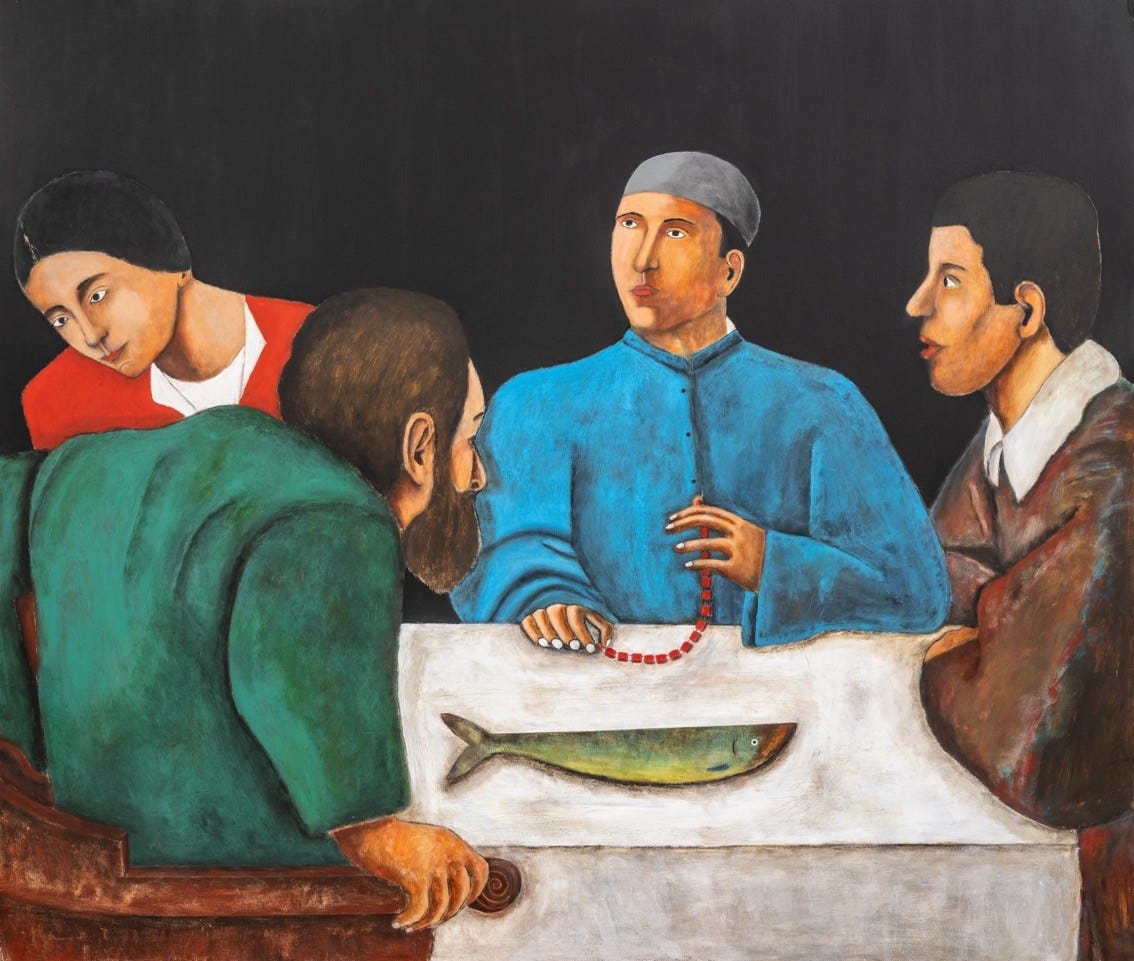
Header image by Temuri Givi Kuliani: “Cleopas and the Unbelievable Story” Reproduced here with kind permission of the artist. www.kulianiart.com